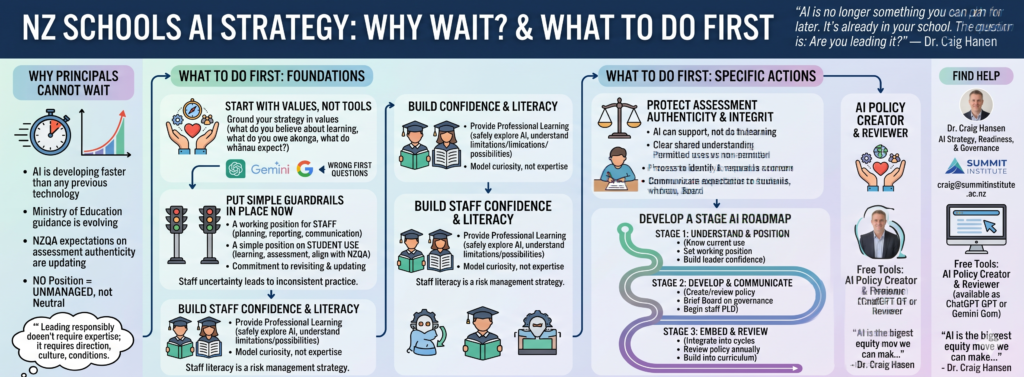
AI is no longer something New Zealand principals can plan to get to later. It is already in your school. It is in the tools your teachers are using at home to plan lessons. It is in the apps your ākonga are accessing on their phones. It is in the way your staff are writing reports, drafting communications, and searching for resources. The question is no longer whether AI is part of your school — it is whether you are leading it.
Dr. Craig Hansen has worked with more than 1,000 schools across New Zealand on AI in education. The pattern he sees most often is not resistance to AI — it is principals who know AI matters but are waiting for the right moment to act. That moment was last year. The schools pulling ahead now are the ones whose leaders have started, even imperfectly.
“Came in today thinking I was confident in what my school and I knew about AI. I was extremely impressed and ecstatic on what I can take away to the other leaders from my school.”
— Senior leader, Waikato school
Why principals cannot wait
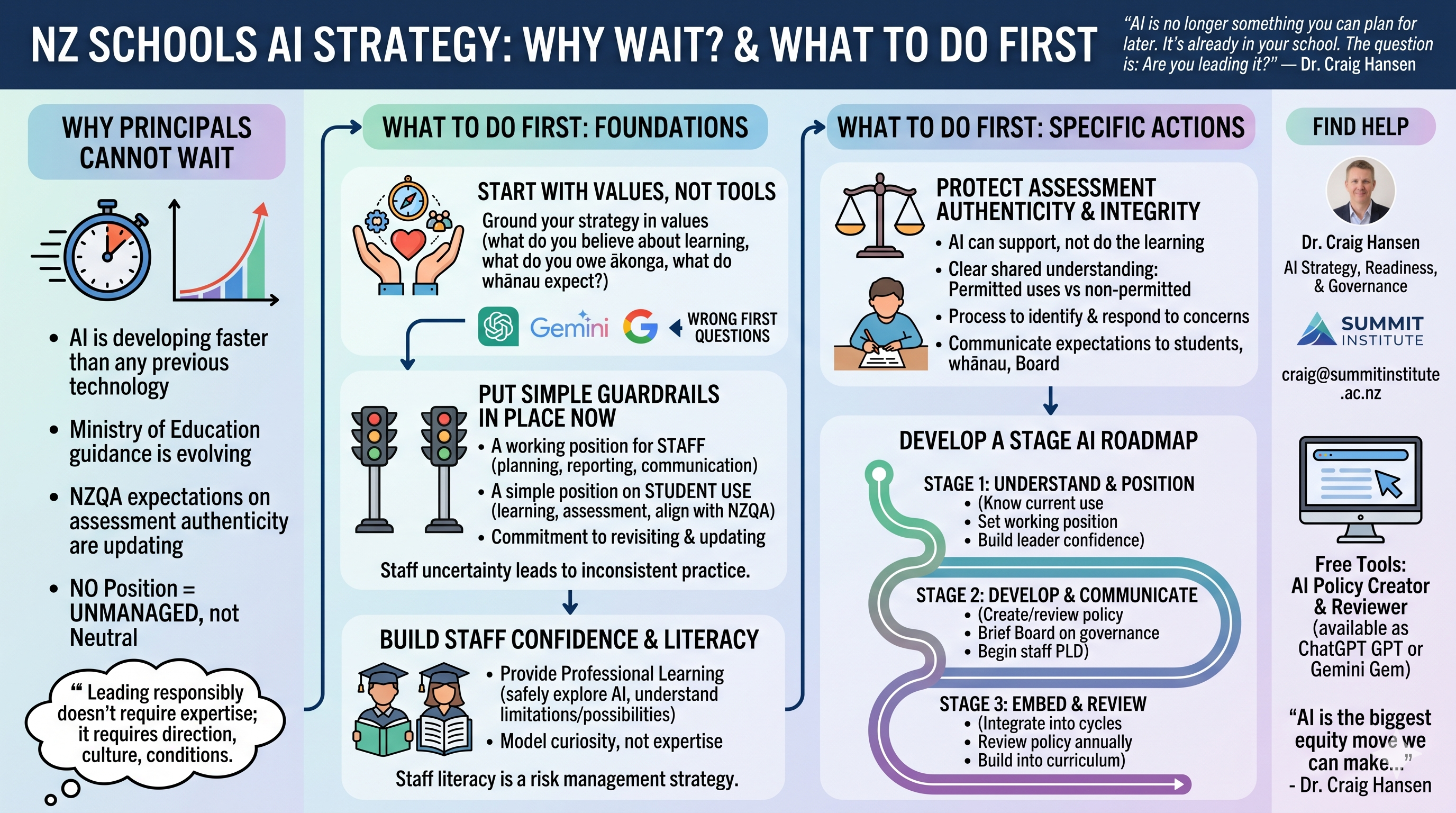
AI is developing faster than any previous technology shift in education. Ministry of Education guidance on AI is evolving. NZQA is actively updating its expectations around assessment authenticity and AI. If your school does not have a clear position on AI use — by staff and by students — you are not in a neutral position. You are in an unmanaged one.
Leading AI responsibly in schools does not require you to be a technology expert. It requires you to do what you already do well: set direction, build culture, and create the conditions for your people to thrive.
Start with your school’s values, not a tool list
The most common mistake principals make is starting with tools. Which AI platform should we use? Should we allow ChatGPT? What about Gemini?
These are the wrong first questions.
Start with your school’s values and your community. What do you believe about learning? What do you owe your ākonga in terms of honest, culturally responsive education? What would whānau expect if they knew AI was being used in your school?
Your AI strategy for schools needs to be grounded in those answers — not in a list of apps. When values come first, the decisions about tools become much clearer.
Put simple guardrails in place now
You do not need a perfect AI policy to start leading. You need a working position — a set of basic expectations that give your staff clarity while you develop a fuller approach.
A practical starting point includes:
- A clear statement on whether and how AI tools can be used by staff for planning, reporting, and communication
- A simple position on student use of AI in learning and assessment, aligned with NZQA assessment integrity expectations
- A commitment to revisiting and updating both as the landscape changes
This does not need to be lengthy. It needs to exist. Staff uncertainty about what is acceptable leads to inconsistent practice — some using AI extensively, others avoiding it entirely. That inconsistency is a leadership gap.
Build staff confidence and AI literacy
Whole-school AI planning only works if your staff feel confident enough to engage. For most schools, that means professional learning before expectation-setting.
Teachers who feel supported to explore AI safely — and who understand its limitations as well as its possibilities — make better decisions about when and how to use it. Staff AI literacy is not just a professional development goal. It is a risk management strategy.
“I want to run whole staff PLD on this and give all our teachers the opportunity to learn what I have today.”
— Senior leader, South Auckland school
The schools making the most progress are those where the principal has modelled curiosity and openness — not expertise. You do not need to know everything. You need to create permission for your team to learn.
Protect assessment authenticity and integrity
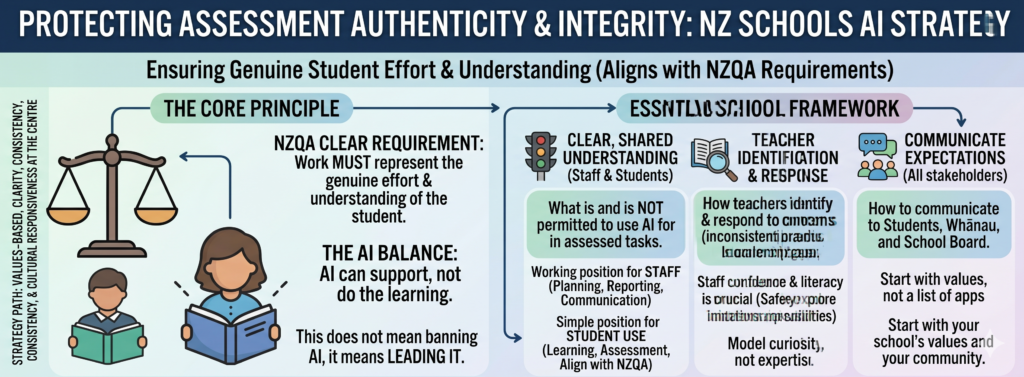
Assessment authenticity is one of the most urgent issues for New Zealand schools right now. NZQA is clear that submitted work must represent the genuine effort and understanding of the student. AI can support the learning process — but it cannot do the learning.
Your school needs a clear, shared understanding of:
- What students are and are not permitted to use AI for in assessed tasks
- How teachers identify and respond to work that raises authenticity concerns
- How you communicate your expectations to students, whānau, and your school board
This does not mean banning AI. It means leading it — with clarity, consistency, and cultural responsiveness at the centre.
Develop a staged AI roadmap
AI readiness for principals is not a one-off decision — it is a staged process. A practical whole-school AI roadmap typically moves through three stages:
Stage one — Understand and position. Know what AI is already being used in your school. Set a working position for staff and students. Build your own confidence through professional learning.
Stage two — Develop and communicate. Create or review your AI policy. Brief your school board on AI governance responsibilities. Begin structured PLD with staff.
Stage three — Embed and review. Integrate AI use into your school’s planning and reporting cycles. Review policy annually. Build AI literacy into your school’s curriculum and culture.
Most New Zealand principals are at stage one. Starting there is not a failure — it is the right place to begin.
“I have so many new tools that I can add to my toolbox. This has been a great investment of my time.”
— Principal, Waikato school
Ready to build your school’s AI roadmap?
Dr. Craig Hansen works with principals and senior leadership teams across New Zealand on AI strategy, readiness, and governance. Contact him to schedule an introductory chat — you’ll map where AI is already showing up in your school, identify your top risks and opportunities, and outline a practical, culturally responsive AI plan for the year ahead.
Get in touch — craig@summitinstitute.ac.nz
Not sure where your school sits on AI readiness? Start with the AI Policy Creator and Reviewer — a free tool that generates a draft AI governance policy for your school or reviews your existing one. Available as a ChatGPT GPT: https://chatgpt.com/g/g-9RWHgaCa5-dr-craig-s-ai-policy-reviewer-upload-generator or a Gemini Gem for Google schools: https://gemini.google.com/gem/1vxfFeGPs93btyPamcIW-IypGyhzarFoZ
“AI is the biggest equity move we can make in our generation.”
— Dr. Craig Hansen, quoted by a principal, Far North school