
Education Week recently published a piece — “When Does AI Help Most With Tutoring? What Emerging Research Says” — examining findings from Stanford’s SCALE Initiative on the effectiveness of AI-assisted tutoring. The research brief cuts through the hype with a clarity I found immediately relevant to our work in Aotearoa New Zealand. I have always said: AI is the biggest equity move in our generation. But the Stanford research reminds us that equity is not delivered by the tool alone. It is delivered by the relationships, the human judgement, and the intentional design that surrounds the tool. The question is not whether AI helps — it is how we deploy it so that the students who need the most support actually receive it.
The Stanford Findings: A Spectrum, Not a Switch
The Stanford brief, published by the National Student Support Accelerator and the AI Hub for Education, categorised AI tutoring along a spectrum of human involvement. Chris Agnew, director of the AI Hub for Education, made a point that resonated deeply: “People hear the term ‘AI tutor,’ and they think that is a young person engaging directly with a chatbot. What our brief outlines is that AI tutors exist on an AI-human spectrum, and that spectrum exists on a range of relational intensity.”
The four models the brief identified — from fully human tutoring through to AI-only tutoring — map almost perfectly onto the conversations I am having with school leaders across Aotearoa. And the evidence is clear: the strongest results come not from replacing human tutors with AI, but from building AI tools for human tutors to use, not for students to use alone.
1. The Human Remains the Heart of the Matter
The Stanford research found that the most effective model was not AI-only tutoring, nor even AI tutoring with human oversight. It was human tutoring with AI support — where a human tutor remains responsible for interacting with the student, and AI assists behind the scenes. This is the model where research indicates it “could be as effective or more effective than human-only tutoring.”
In the NZ context, this means the principals and teachers I work with through Summit Institute are not being replaced by AI. They are being augmented. The AI handles the repetitive scaffolding — generating practice materials, drafting differentiated reading levels, analysing patterns in student work — while the teacher does what only a teacher can do: build relationships, read the room, respond with cultural intelligence, and make the pedagogical decisions that no algorithm can replicate.
“Tutoring research tells us that relationships are a key part in student persistence, student engagement, and hitting dosage that allow sustained improvement in student outcomes. Access to a tool is not enough.” — Chris Agnew, Stanford SCALE Initiative
That quote should be printed on every AI policy document in every school in Aotearoa. Access to a tool is not enough. Access to a relationship is what drives outcomes. When I work with Dr Craig Hansen on AI integration, the starting point is never the technology. It is the teacher-student relationship and how AI can protect and extend it — not replace it.
2. AI-Only Tutoring Fails the Students Who Need It Most
One of the most sobering findings in the Stanford brief was about AI-only tutoring — where students work directly with AI without human oversight. A study found that when left to work independently, 40-47% of students never used the AI platform. This is the equity trap. If we deploy AI tutoring without human structure, the students who are already disengaged — the very students we are trying to reach — will disengage further. The gap widens instead of narrowing.
This is precisely why I argue that AI is an equity move when it is designed well. Give a disengaged student an AI tool and no human support, and you have widened the gap. Give a teacher an AI tool that saves them three hours of preparation time, and you have given them three more hours to spend in relationship with their students. That is the equity move. That is what I mean when I say AI is the biggest equity move in our generation — not because the technology is inherently equitable, but because it can liberate the human capacity that drives equity.
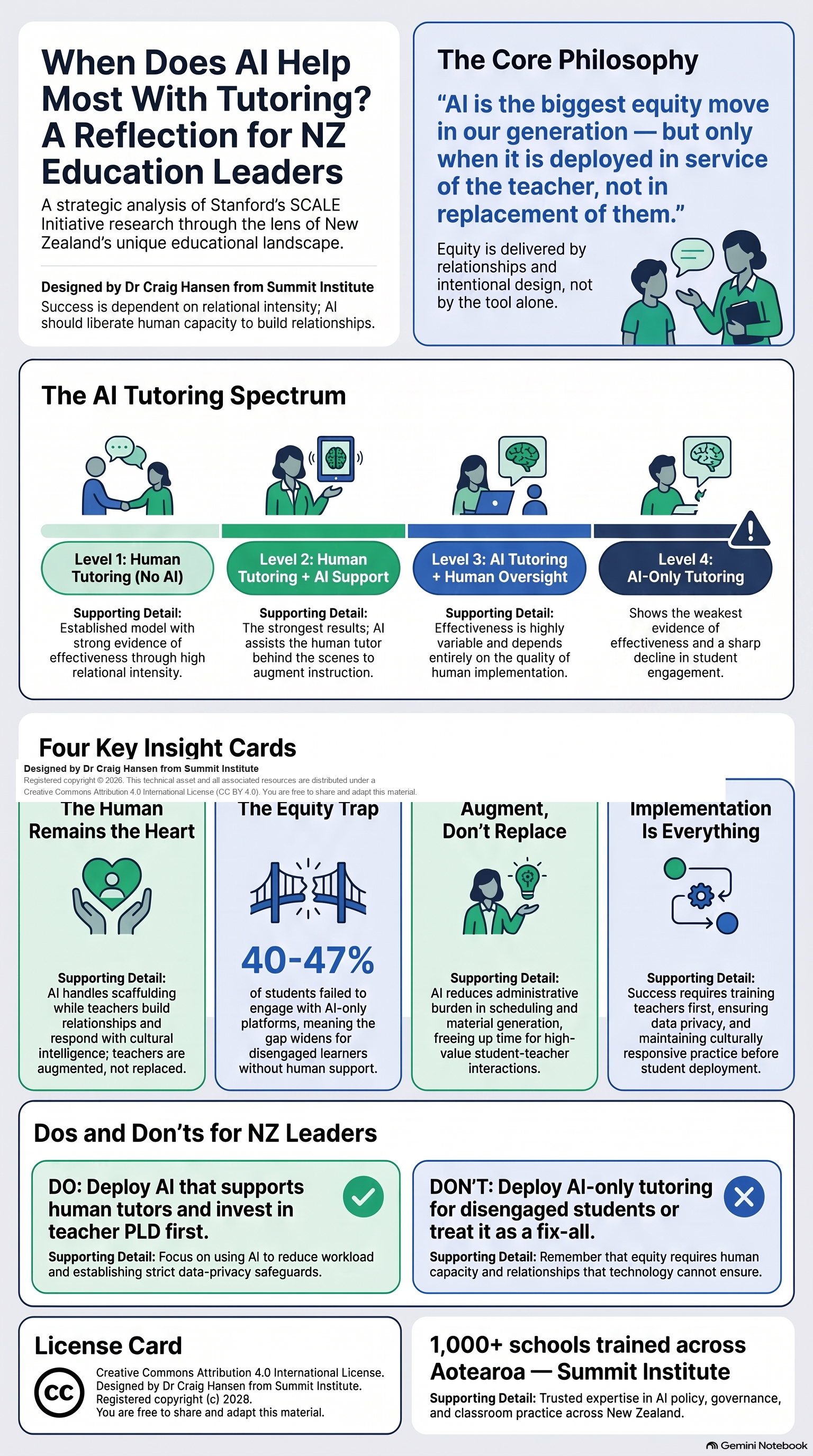
Infographic by Dr Craig Hansen, Summit Institute. Click to view full size. Distributed under CC BY 4.0.
3. Augment, Don’t Replace
The Stanford brief outlined specific use cases where AI enhances human-led instruction rather than replacing it: streamlining master scheduling, enhancing tutor training through realistic practice simulations, and generating targeted student practice materials with a tutor reviewing them before implementation.
Matthew Kraft, a professor of education and economics at Brown University, offered a caution that I think every board chair and principal should hear: “AI cannot ensure you meet the basic elements of successful tutoring — high attendance, sustained tutoring over time, and strong relationships.” He is right. But what AI can do is reduce the administrative burden that prevents those basics from happening. If a teacher spends less time on data entry and scheduling, they have more capacity for the relationships that matter.
Before adopting AI tools, the Stanford researchers recommend that leaders prioritise applications that augment human-led instruction and operational capacity and establish strict student data-privacy safeguards. This aligns directly with what we do at Summit Institute — our AI governance and PLD programmes help schools adopt AI in ways that protect student data, preserve academic integrity, and enhance rather than erode the human relationships at the centre of learning.
4. The Implementation Question
Agnew noted that for the model where students engage directly with AI while a human tutor oversees, “implementation determines effectiveness.” This is the key insight for NZ school leaders. The same AI tool can be transformative in one school and ineffective in another, depending entirely on how it is implemented.
Effective implementation means: teachers are trained on the tool before students use it. It means the tool is integrated into existing learning pathways, not bolted on as an afterthought. It means data privacy is addressed before deployment, not after. It means culturally responsive practice is maintained — the AI does not override the local context, the kura values, or the relationships between teacher and student.
This is why the professional development programmes we deliver at Summit Institute are not technology workshops. They are pedagogy workshops that happen to use AI. The technology is the enabler; the pedagogy is the point.
What This Means for New Zealand’s Educational Leaders
The Stanford research gives us a clear set of principles to guide AI tutoring adoption in NZ schools. Here is my adaptation:
- Do deploy AI tools that support human tutors, not replace them. The evidence is strongest for this model.
- Do invest in teacher PLD before introducing AI to students. Implementation determines effectiveness.
- Do use AI to reduce teacher workload — scheduling, resource generation, differentiation — so that more time is available for relationships.
- Do establish strict student data-privacy safeguards before adopting any AI tool.
- Don’t deploy AI-only tutoring for disengaged students without human oversight. 40-47% will not engage, and the equity gap will widen.
- Don’t treat AI as a fix-all. It cannot ensure attendance, sustained engagement, or strong relationships — the fundamentals of effective tutoring.
- Don’t forget that AI is the biggest equity move in our generation only when it is designed to liberate human capacity, not replace it.
The Stanford brief is a reminder that the rest of the world is grappling with the same questions we are. How do we scale tutoring in an era of constrained funding? How do we personalise learning without losing the human relationships that make learning stick? How do we use AI to close gaps rather than widen them?
For me, the answer is consistent: AI is the biggest equity move in our generation — but only when it is deployed in service of the teacher, not in replacement of them. When it gives a teacher in a small rural kura the same capacity to differentiate as a teacher in a well-resourced urban school, that is equity. When it frees a principal from administrative burden so they can spend more time in classrooms, that is equity. When it provides a student who has fallen behind with the targeted practice they need — wrapped inside a relationship with a teacher who knows them — that is equity.
That is what we do at Summit Institute. That is the work. And the Stanford research confirms we are on the right track.
Source article: Langreo, L. (2026). When does AI help most with tutoring? What emerging research says. Education Week. https://www.edweek.org/technology/when-does-ai-help-most-with-tutoring-what-emerging-research-says/2026/08
Listen to the ChatAI Podcast with Dr Craig Hansen
Join Craig on the @summitinstitute YouTube channel for conversations with educators, technologists, and leaders exploring AI in education — practical, grounded, and always focused on what matters for learners.
Ready to Lead AI in Your School?
Summit Institute delivers Ministry of Education accredited PLD and AI facilitation for school boards, principals, and teachers across Aotearoa New Zealand. Whether you need a board AI governance workshop, a staff PLD session, or a tailored AI strategy for your kura — we can help.
Reference
Langreo, L. (2026, August 28). When does AI help most with tutoring? What emerging research says. Education Week. https://www.edweek.org/technology/when-does-ai-help-most-with-tutoring-what-emerging-research-says/2026/08