When New Zealand’s leading educational research body published their landmark 2024 survey of primary school teachers and students, it confirmed something many of us working in schools could already feel.
Dr. Craig Hansen has trained more than 1,000 schools across Aotearoa New Zealand on AI in education. Here is what the NZCER research revealed — and what he is seeing two years on.
What the 2024 research found
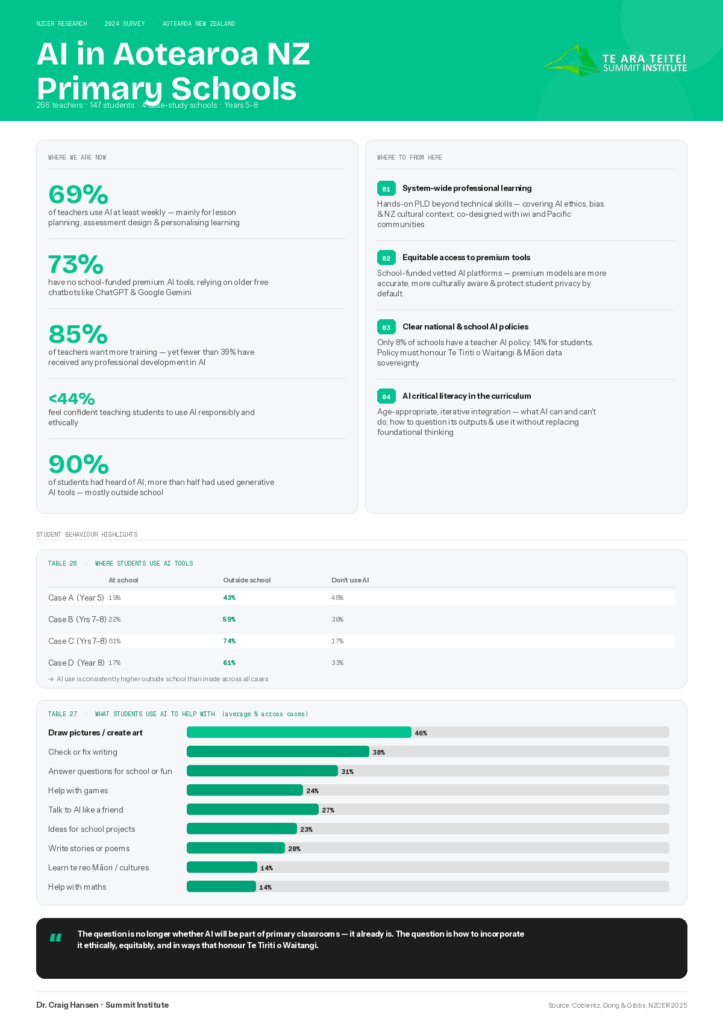
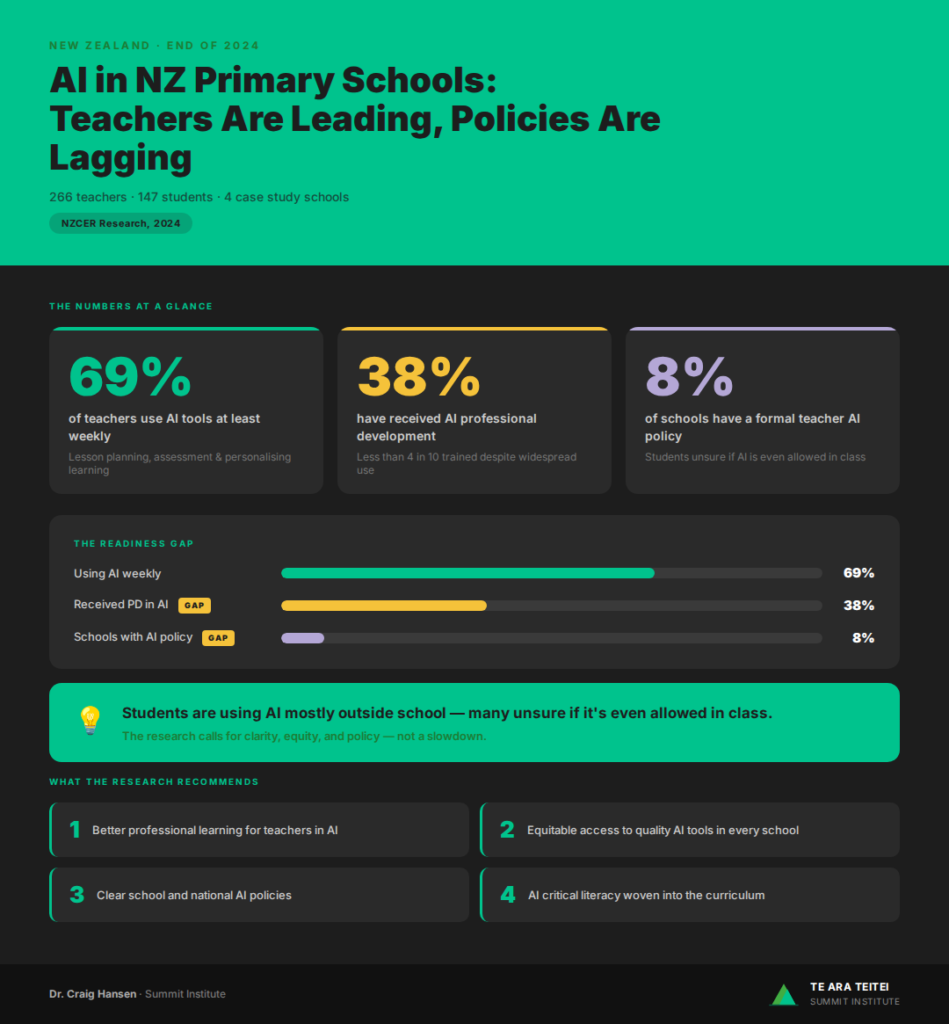
The New Zealand Council for Educational Research (NZCER) surveyed 266 primary school teachers and 147 students across four case study schools at the end of 2024. The findings were both validating and urgent.
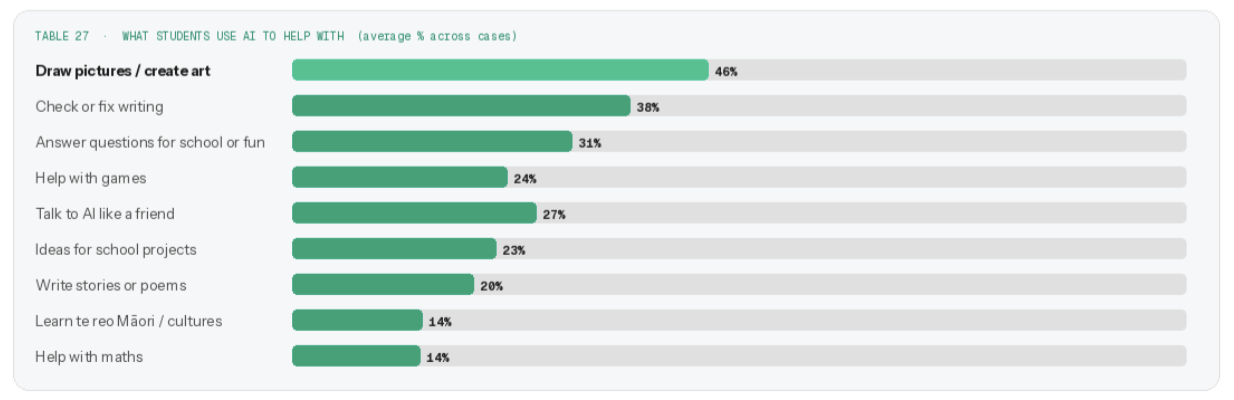
Nearly seven in ten teachers were already using AI tools at least weekly — mainly for lesson planning, assessment design, and personalising learning. Yet fewer than four in ten had received any professional development in AI, and only eight percent of schools had a formal teacher AI policy in place. Students were using AI mostly outside school, many of them unsure whether they were even allowed to use it in class.
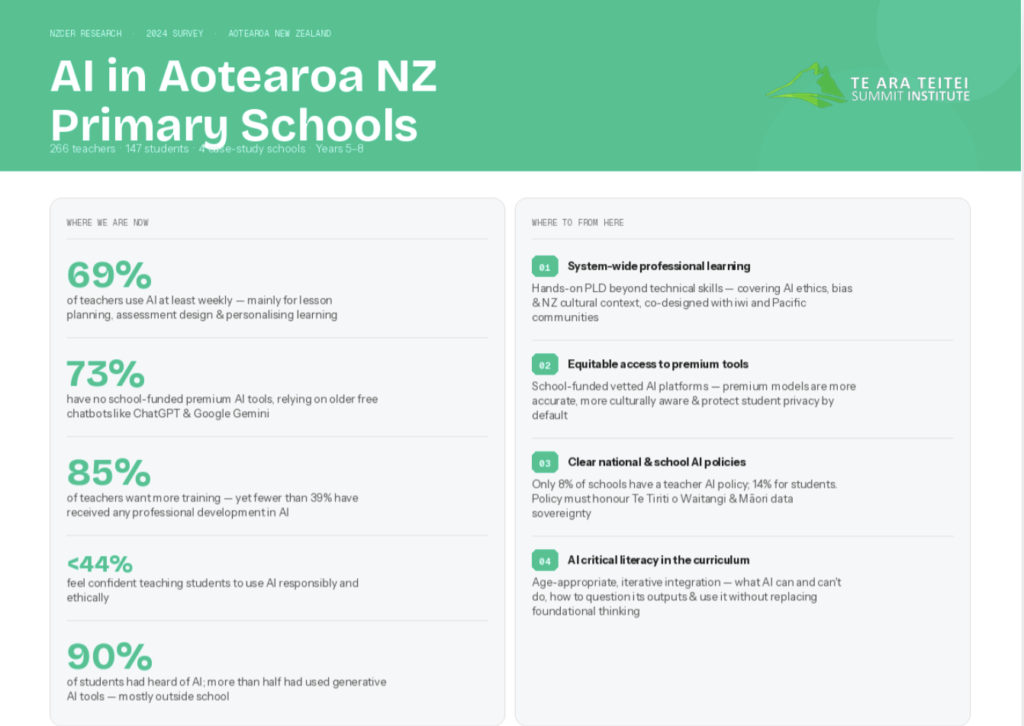
The research called clearly for four things: better professional learning, equitable access to quality tools, clear school and national AI policies, and AI critical literacy woven into the curriculum.
“This was really informative, and provided excellent knowledge and insights into using AI as a teacher and leader. I want to run whole staff PLD on this and give all our teachers the opportunity to learn what I have today.”
— Senior leader, South Auckland school, recent AI workshop attendee
What has shifted by 2026
Fast forward to 2026, and after working alongside hundreds of school leaders in workshops across Aotearoa, the picture has shifted considerably.
One of the most encouraging moves has been schools taking governance seriously and actually getting it done. Many principals have adapted their SchoolDocs policies to fit their specific community context. A good number have used tools like the AI Policy Creator and Reviewer — available as a ChatGPT custom GPT and a Gemini Gem — to draft and peer-review those policy documents. It is a beautifully meta moment: using AI to think carefully about how you use AI. It is practical, fast, and it gets the conversation happening at a board and staff level where it matters most.
- ChatGPT AI Policy Creator: https://chatgpt.com/g/g-9RWHgaCa5-dr-craig-s-ai-policy-reviewer-upload-generator
- Gemini Gem version: https://gemini.google.com/gem/1vxfFeGPs93btyPamcIW-IypGyhzarFoZ
“Came in today thinking I was confident in what my school and I knew about AI. I was extremely impressed and ecstatic on what I can take away to the other leaders from my school.”
— Senior leader, Waikato school, recent AI workshop attendee
What is genuinely exciting in 2026
What is most encouraging is what is happening beyond the official toolkit.
Innovative principals and teachers are exploring on their own time — testing Claude, Perplexity, TeachAid, TeacherGPT, and Chalkie alongside school-provided platforms. They are developing real AI fluency, not just tool familiarity, and that curiosity is contagious in a staffroom.
At the senior leadership level, some of the most impressive work is around Student and Learning Management Systems with AI built in — where analytics and progress data are visible to teachers and families in near real time. Formative responses to a student’s learning are happening in hours, not the weeks or months a traditional reporting cycle would take. That is a genuine shift in what is possible for tamariki.
“I really enjoyed the morning — there is so much AI out there and I am excited to share this with our staff.”
— Principal, Marlborough school, recent AI workshop attendee
What still needs to happen
The 2024 NZCER research called for professional learning, equitable access, clear policy, and AI literacy in the curriculum. All of that still holds, and the work is far from done.
The research found that most schools were still relying on free tools — older, less capable models more prone to error and cultural bias. The Ministry of Education’s guidance webpage had been viewed by fewer than four in ten of the teachers surveyed. And the cultural dimension remains critical: many common AI tools continue to reflect predominantly Western perspectives, with limited knowledge of te reo Māori and mātauranga Māori.
These gaps matter. Equity gaps in AI adoption mirror equity gaps in education more broadly — and if professional learning and quality tools flow mainly to well-resourced schools, the digital divide widens rather than closes.
From anxiety to agency
What the 2024 research could not yet capture is something visible in every workshop in 2026: educators who have moved from anxiety to agency. School leaders who are asking better questions, building better systems, and bringing their communities along with them.
If you are still on the edge of this, know that you do not need to have it all figured out. Start with your policy. Find the tools that fit your context. Connect with others doing the same work.
The path forward is clearer than it has ever been, and you do not have to walk it alone.
“AI is the biggest equity move we can make in our generation.”
— Dr. Craig Hansen, quoted by a principal, Far North school, recent AI workshop attendee
To schedule an introductory chat about AI professional learning for your school or leadership team, contact craig@summitinstitute.ac.nz
You can also generate or review your school’s AI policy using the AI Policy Creator and Reviewer — available as a ChatGPT GPT (https://chatgpt.com/g/g-9RWHgaCa5-dr-craig-s-ai-policy-reviewer-upload-generator) and a Gemini Gem (https://gemini.google.com/gem/1vxfFeGPs93btyPamcIW-IypGyhzarFoZ).
Reference
Coblentz, D., Dong, J., & Gibbs, B. (2025). Generative artificial intelligence in Aotearoa New Zealand primary schools: Teacher and student survey findings. New Zealand Council for Educational Research. https://doi.org/10.18296/rep.0077