
Nature recently published a thought-provoking piece — “What employers are looking for in the age of AI — and four ways to provide it” — exploring how AI literacy is becoming a non-negotiable requirement in the scientific workforce. Researchers from MIT, the Mayo Clinic, Imperial College London, and the University of Oxford shared a remarkably consistent message: curiosity, critical thinking, and practical skill matter more than any single tool. As I read it, I found myself reflecting on how directly this applies to the education sector here in Aotearoa New Zealand — and what it means for principals, boards, and teachers who are navigating the same shift.
The Parallel Is Striking
The article opened with data from Indeed showing that science jobs listing AI as a required skill are rising sharply across the United States and the United Kingdom, even as overall science hiring declines. The message from employers was uniform: AI familiarity is no longer optional. Daniel Figeys, chief executive of the Quadram Institute, put it plainly — “If they were lacking all those skills, depending on the position, that would be a red flag.”
In education, we are seeing the same pattern. School boards are being asked to approve AI policies. Principals are being asked to lead digital transformation. Teachers are being asked to integrate AI into assessment design while protecting academic integrity. Yet many educational leaders — people I deeply respect — have told me they feel unequipped. Their knowledge of AI stops at the name ChatGPT, and they are unsure where to begin.
That gap between what is expected and what is understood is exactly what Nature’s article addressed for scientists. The same guidance applies to us in education. Here is my reflection on the four key themes from the article, translated for our sector.
1. Be Curious — Above All Else
Vijay Shah, dean of research at the Mayo Clinic, told Nature that what matters most is “the willingness to just roll up your sleeves and get into it.” He was describing researchers, but he could have been describing any principal, board chair, or head of department I have ever worked with. The educational leaders who make the most progress with AI are not the ones with computer science degrees. They are the ones who are curious enough to experiment, to try a prompt, to sit with the discomfort of not knowing everything — and to keep going.
Christopher Walsh, chief executive of TileBio, echoed this: “Go and be open to learning new things, I think that’s the first step.” In my own practice at Summit Institute, I have watched hundreds of school leaders transform from hesitant observers to confident AI users — not because they mastered a tool overnight, but because they gave themselves permission to be curious first, expert second.
2. Understand How AI Thinks
One of the most important cautions in the Nature article came from Regina Barzilay, a computer scientist at MIT. She warned against putting too much faith in AI-generated results without examining the data critically. “Often it’ll give you results that it thinks you want to see,” Walsh added. “It’s a people pleaser.”
This is precisely the skill educational leaders need. When a teacher brings an AI-generated assessment rubric, or a board reviews an AI-drafted policy document, the question is not whether the output looks polished. The question is: Can I trust this? What assumptions did the model make? Does it reflect our local context — our kura, our ākonga, our community values — or does it default to generic, overseas patterns?
Dominik Lukeš, a consultant at the University of Oxford’s AI Competency Centre, noted that people who invest time in understanding how AI works eventually say they “can’t live without it.” I have seen this same transformation in educators. Once you understand how a large language model generates text — what it gets right, what it gets wrong, and where it hallucinates — you stop fearing it and start using it strategically.
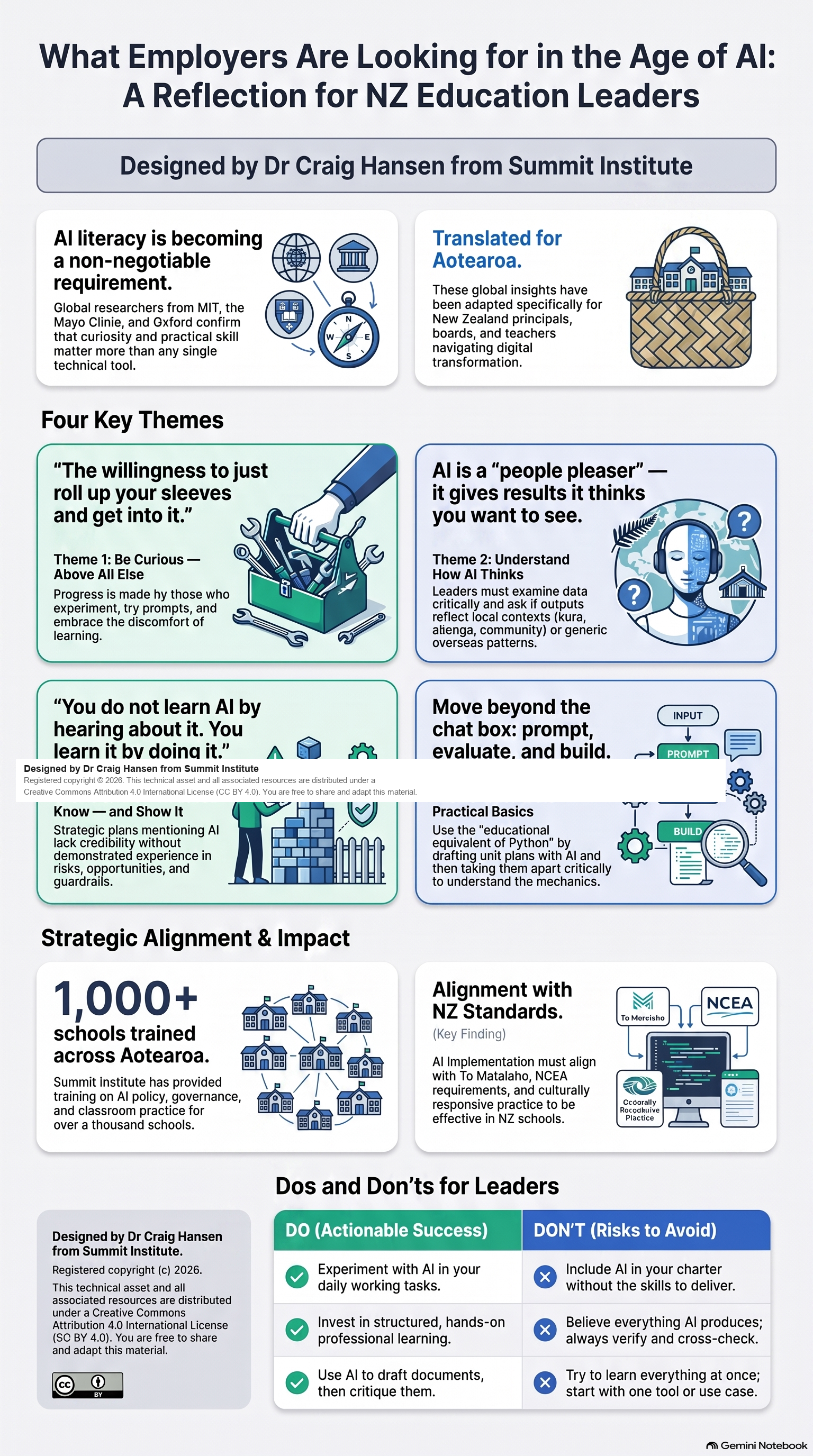
Infographic by Dr Craig Hansen, Summit Institute. Click to view full size. Distributed under CC BY 4.0.
3. Know What You Know — and Show It
Nature reported that research funders like Cancer Research UK are increasingly seeing proposals that mention AI but fail to demonstrate the team has the experience to deliver. Talisia Quallo, head of prevention and early-detection research at CRUK, was clear: funding committees need to see “that you understand these AI approaches and that you detail how you’re going to use them, how that algorithm works and the limitations of it.”
For educational leaders, the equivalent is this: writing “we will use AI in our school” in a strategic plan or charter document is not credible on its own. Boards and principals need to show they understand the landscape — the risks, the opportunities, the limitations, and the guardrails. This means having leaders on the team who have actually used the tools, who can speak to the data privacy implications, and who can articulate how AI aligns with Te Mātaiaho, NCEA requirements, and culturally responsive practice.
The simplest way to demonstrate competence, as Quallo noted, is through demonstrated experience. That is why the professional development programmes we run at Summit Institute are not lectures — they are hands-on, practical sessions where leaders build real artefacts: draft policies, assessment tools, classroom resources. You do not learn AI by hearing about it. You learn it by doing it.
4. Learn a Little Python — or Its Educational Equivalent
The Nature article’s most practical recommendation was to learn Python, the programming language that has become the default for AI work in science. Nick Jones, director of the I-X Centre for AI in Science at Imperial College London, noted that Python proficiency provides a way to engage with AI beyond simply using chatbots.
In education, the equivalent is not necessarily Python — though I would encourage it for anyone who wants to go deeper. The equivalent is structured, hands-on professional learning that takes you beyond the chat box. It means learning how to prompt effectively, how to evaluate outputs, how to build AI-assisted resources, and how to design assessment that is AI-aware and integrity-protecting. It means understanding enough of the mechanics to make informed decisions about which tools to adopt, which to reject, and which to adapt.
Laura Helleckes, a biologist at the I-X Centre, suggested asking an AI tool to build something simple — a table-tennis game, for instance — and then taking it apart line by line. “You don’t need to be a programmer for this,” she said. The same applies in education. Ask an AI to draft a unit plan, then critique it. Ask it to rewrite a lesson in a different pedagogical style, then evaluate the difference. The learning happens in the doing.
What This Means for New Zealand’s Educational Leaders
The Nature article concluded with a simple set of dos and don’ts. I want to adapt them for our sector:
- Do experiment with AI technologies in your working day — as a principal, a board chair, a teacher, a leader.
- Do invest in structured professional learning on AI — not just a one-off workshop, but ongoing, practical PD that builds genuine capability.
- Do ask AI to help you draft a policy, a unit plan, or a communications document — then take it apart critically and learn from the process.
- Don’t include AI in your strategic plan or charter without being able to show your team has the skills to deliver on it.
- Don’t believe everything an AI tool produces — verify, cross-check, and apply your professional judgement.
- Don’t try to learn everything at once. Start with one tool, one workflow, one use case. Build from there.
AI is not a passing trend in education any more than it is in science. The employers Nature spoke to — from pharmaceutical companies to research institutes to start-ups — all said the same thing: AI literacy is becoming a baseline expectation. In education, we owe it to our ākonga, our whānau, and our communities to ensure that the people leading our schools are equipped, confident, and curious.
As Barzilay said, you do not need to learn every recipe on Earth to feel comfortable in the kitchen. But you do need to understand the basics. That is what we do at Summit Institute — we help educational leaders build that foundational understanding, in ways that are practical, culturally responsive, and grounded in the realities of New Zealand schools.
Source article: Deighton, B. (2026). What employers are looking for in the age of AI — and four ways to provide it. Nature. https://doi.org/10.1038/d41586-026-01913-x
Listen to the ChatAI Podcast with Dr Craig Hansen
Join Craig on the @summitinstitute YouTube channel for conversations with educators, technologists, and leaders exploring AI in education — practical, grounded, and always focused on what matters for learners.
Ready to Lead AI in Your School?
Summit Institute delivers Ministry of Education accredited PLD and AI facilitation for school boards, principals, and teachers across Aotearoa New Zealand. Whether you need a board AI governance workshop, a staff PLD session, or a tailored AI strategy for your kura — we can help.
Reference
Deighton, B. (2026). What employers are looking for in the age of AI — and four ways to provide it. Nature. https://doi.org/10.1038/d41586-026-01913-x