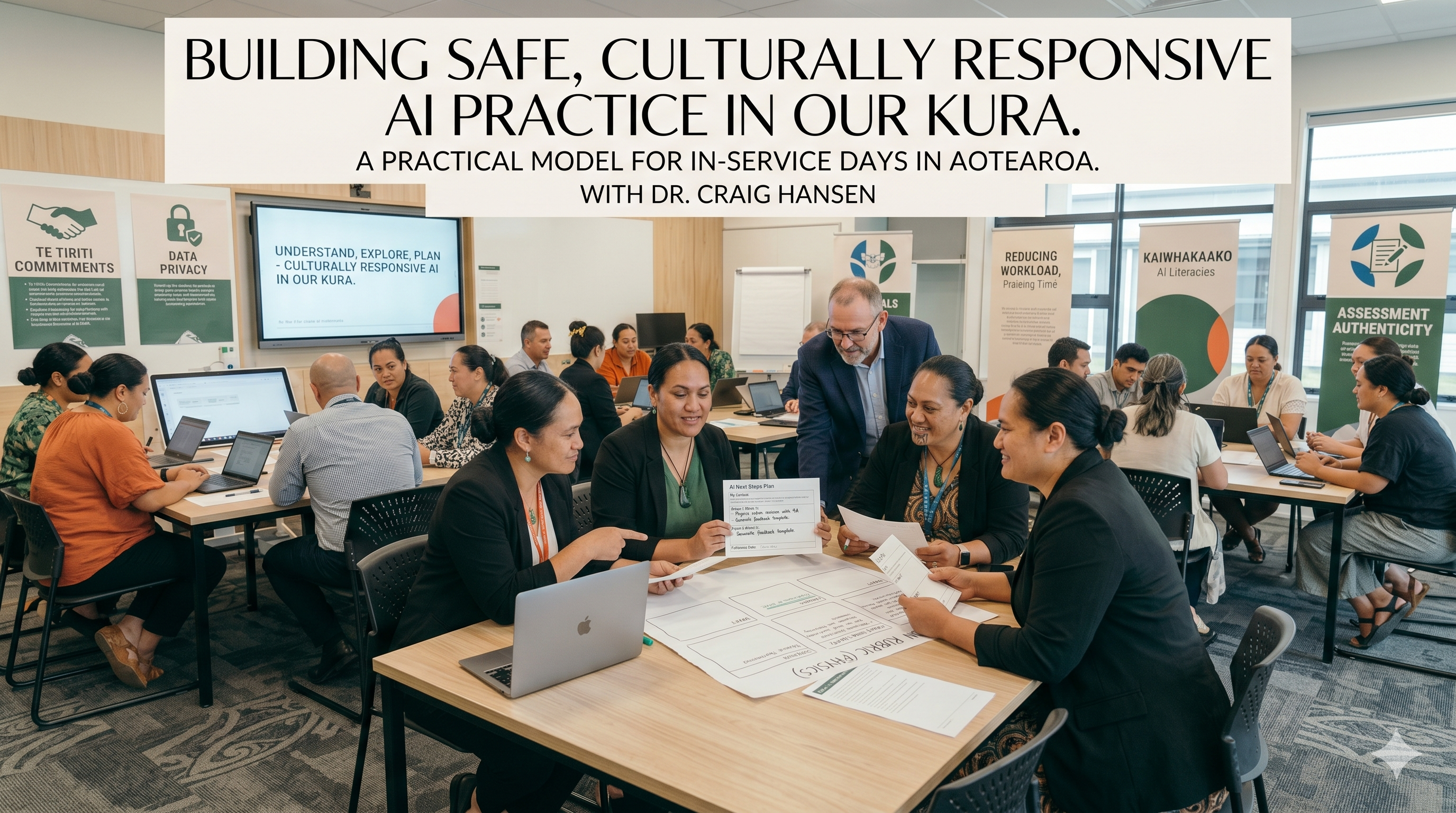
Dr. Craig Hansen has worked with more than 1,000 schools across New Zealand on AI in education. One question comes up more than almost any other: “How do we bring our whole staff along?”
The answer, for many schools, starts with a teacher-only day.
A well-designed AI in-service day doesn’t need to be overwhelming. It doesn’t need to cover every tool available. And it doesn’t need to make anyone feel like they’re falling behind. Done well, it builds genuine confidence, surfaces the teachers who are ready to lead, and gives your whole kura a shared language and starting point for AI use.
This article outlines a practical model for designing an AI-focused in-service day that is safe, culturally responsive, and directly useful for classroom practice.
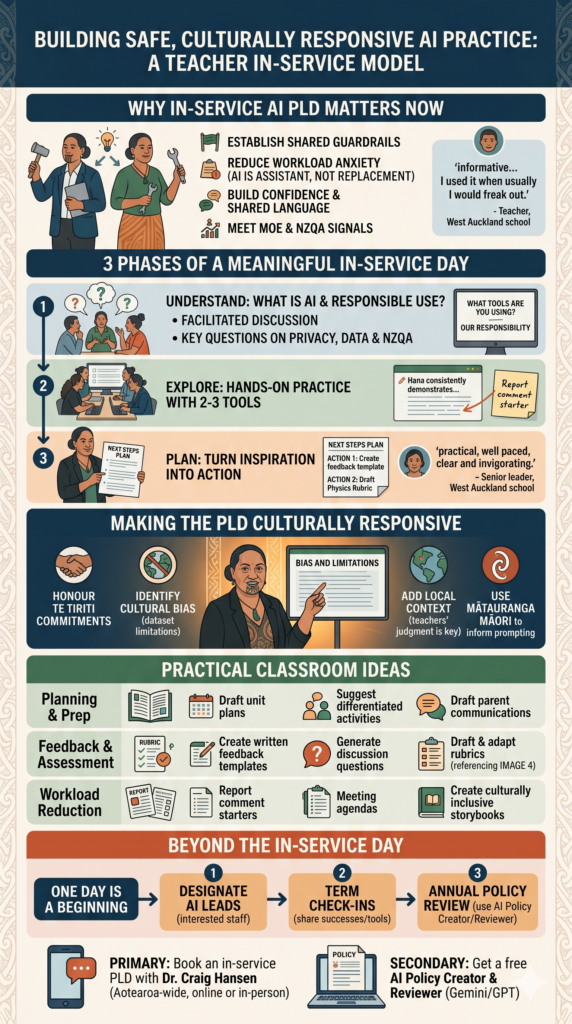
Why teacher in-service AI PLD matters now
AI tools are already in your staffroom — whether or not they’ve been introduced formally.
Some teachers are using them quietly for lesson planning and report writing. Others are avoiding them because they feel uncertain or unsupported. A small number may be using them in ways that haven’t been thought through for your school’s context, values, or student privacy.
An in-service day creates a shared foundation. It means every teacher leaves with the same basic understanding, the same guardrails, and the same practical starting points — regardless of their current confidence level.
“I found the lesson very informative. I was able to use it when usually it is something I would freak out about.”
— Teacher, West Auckland school
The Ministry of Education and NZQA have both signalled that AI is here to stay in education. Schools that wait for a perfect policy before starting PLD risk leaving their staff to navigate this alone. Starting with a structured, safe in-service day is one of the most practical steps a principal or senior leader can take right now.

Clarify the purpose: AI as assistant, not replacement
The most important thing you can establish at the start of any AI in-service day is this: AI is a tool that supports teachers, not a replacement for their professional judgment, their relationships, or their craft.
This framing matters because it removes the anxiety that many teachers carry into any AI conversation. When staff understand that the goal is to reduce workload and free up more time for what only teachers can do — build relationships, make professional judgments, respond to the real needs of ākonga — the conversation shifts from threat to opportunity.
Practically, this means the opening of your in-service day should:
- Acknowledge that teachers may have mixed feelings about AI, and that this is valid.
- Establish that the school’s values and Te Tiriti commitments remain at the centre of every decision about AI use.
- Be clear about what is and isn’t appropriate use in your school context.
- Name the tools you’ll be exploring — and why you’ve chosen them.
Designing a meaningful AI in-service day
A useful AI in-service day has three phases: understand, explore, and plan.
Understand — What is AI, and what does responsible use look like in our school?
This phase covers the basics clearly and quickly. It doesn’t need to be a lecture. A short facilitated discussion around key questions works well: What tools are you already using? What feels uncertain? What does our school need to think about in terms of student data, privacy, and NZQA assessment integrity?
Explore — Hands-on practice with two or three practical tools.
Keep this focused. Choosing two or three tools and giving teachers real time to try them — with a specific task from their own work context — is far more valuable than a broad survey of everything available. Practical AI PLD for teachers in Aotearoa works best when it’s immediately applicable. Ask teachers to try drafting a unit plan, a parent newsletter, or a set of differentiated reading tasks using an AI tool while you walk alongside them.
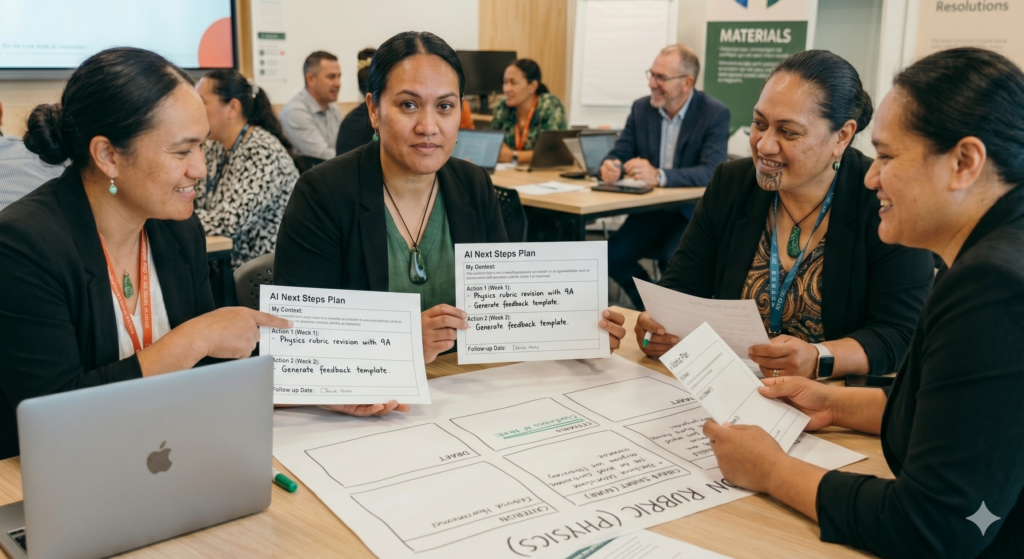
Plan — What will I actually do next week?
This is the step most in-service days miss. Before the day ends, every teacher should write down one or two specific ways they’ll use AI in their work in the coming fortnight. This turns inspiration into action and gives your leadership team something to follow up on.
“This was practical, well paced, clear and invigorating.”
— Senior leader, West Auckland school
Making the PLD culturally responsive and inclusive
A culturally responsive AI in-service day doesn’t treat AI as culturally neutral — because it isn’t.
AI tools are built on large datasets that often reflect dominant cultural perspectives. For kura working with Māori and Pacific ākonga, this matters. It shapes which voices are centred, which examples feel relevant, and which language and contexts feel invisible.
Culturally safe AI practice means:
- Choosing tools and examples that reflect the diversity of your school community.
- Being honest with teachers about the limitations of AI — including bias and the risk of homogenising content.
- Encouraging teachers to add their own cultural context rather than accepting AI outputs uncritically.
- Exploring how mātauranga Māori and local knowledge can inform the way teachers prompt and evaluate AI-generated content.
- Discussing assessment authenticity — and how to help ākonga engage with AI as a thinking tool, not a shortcut.
Building AI literacy in a culturally responsive way also means making sure the PLD itself is delivered in a manner that honours different starting points, learning styles, and comfort levels. Sandpit time — unstructured exploration — is essential. Not every teacher will move at the same pace, and that’s okay.
Practical classroom ideas teachers can take away
By the end of your in-service day, teachers should have at least two or three concrete ideas ready to try. Here are practical starting points organised by use:
Planning and preparation
- Use AI to generate a first draft of a unit plan, then edit it to reflect your class and context.
- Ask AI to suggest differentiated learning activities for a given achievement objective.
- Use AI to draft parent communications, then personalise for tone and whānau relationships.
Feedback and assessment support
- Draft written feedback templates aligned to your school’s assessment approach.
- Generate a bank of discussion questions for a reading text or learning focus.
- Create rubric drafts and adapt them for your context.
Reducing workload
- Use AI for report comment starters — then rewrite them in your own words for each student.
- Generate meeting agendas, professional learning notes, or timetabling drafts.
- Create culturally inclusive storybooks or reading resources for your class using AI image and text tools.
All of these are starting points — not finished products. The teacher’s professional judgment and knowledge of their ākonga is what turns an AI draft into something genuinely useful.
Building ongoing AI PLD beyond one in-service day
A single in-service day is a beginning, not a solution.
The schools that make the most meaningful progress with AI are those that build ongoing capability through regular professional learning conversations, peer sharing, and leadership modelling. Some practical next steps after your in-service day:
- Designate one or two teachers as your AI leads — people with interest and capacity to stay current and support colleagues.
- Build a short AI check-in into a staff meeting each term — five minutes to share one tool, one success, or one question.
- Review your school’s AI policy annually, and make sure it reflects what teachers are actually doing.
- Consider a follow-up in-service session in the second half of the year, once teachers have had time to experiment.
“I want to run whole staff PLD on this and give all our teachers the opportunity to learn what I have today.”
— Senior leader, South Auckland school
One in-service day, well designed, can shift the culture of a staffroom. The conversations it starts — about safe use, culturally responsive practice, and the role of AI in teaching and learning — are the ones that matter most.
“AI is the biggest equity move we can make in our generation.”
— Dr. Craig Hansen, quoted by a principal, Far North school
Book an AI in-service day for your school
Dr. Craig Hansen delivers AI in-service PLD sessions for school staff across New Zealand — in person or online. Sessions are practical, culturally responsive, and designed to build genuine confidence at every level of experience. Book a 30-minute planning conversation with Craig to map out what an in-service day could look like for your kura.
Already working on your school’s AI policy? Use the free AI Policy Creator and Reviewer — available as a ChatGPT GPT or Gemini Gem for Google schools — to generate a draft policy or review an existing one.