
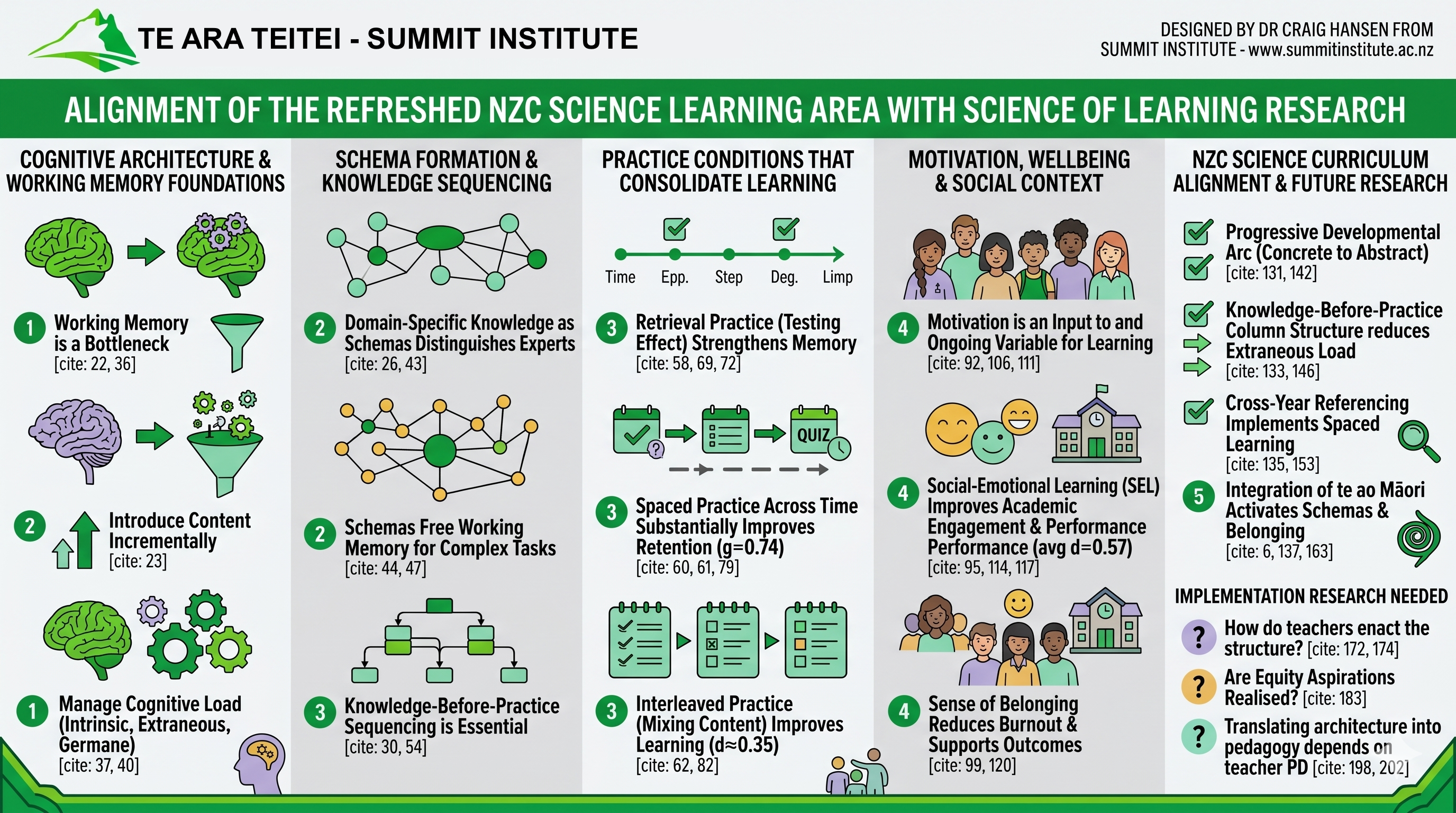
“How do we use the Science of Learning to successfully implement the refreshed NZC Science Curriculum in the classroom?”
By anchoring the refreshed New Zealand Science Curriculum in the proven ‘Science of Learning’—from the hard limits of working memory to the cultural power of te ao Māori—we can transform complex cognitive research into highly effective, practical classroom strategies that truly elevate student success.
1. Cognitive Architecture & Working Memory Foundations
- Working Memory Limitations: Working memory acts as a strict bottleneck for learning because it can only hold a limited amount of information at one time.
- Incremental Introduction: To prevent cognitive overload, new scientific content must be introduced gradually and in small steps.
- Managing Cognitive Load: Effective lesson design must manage and balance three types of cognitive load: intrinsic (inherent difficulty of the topic), extraneous (how the information is presented), and germane (the mental processing dedicated to building schemas).
2. Schema Formation & Knowledge Sequencing
- Domain-Specific Schemas: Experts are distinguished from novices by their deeply interconnected networks of domain-specific knowledge, known as schemas.
- Freeing Working Memory: Developing well-established schemas frees up limited working memory capacity, allowing students to tackle complex scientific tasks.
- Knowledge-Before-Practice: Content must be sequenced so that students acquire foundational knowledge before they are asked to apply it in practical or inquiry-based activities.
3. Practice Conditions That Consolidate Learning
- Retrieval Practice: Frequently testing or recalling information (the “testing effect”) strengthens long-term memory pathways.
- Spaced Practice: Spreading learning opportunities out over time—rather than cramming—substantially improves long-term knowledge retention.
- Interleaved Practice: Mixing different types of topics or problems together during study sessions improves overall learning outcomes compared to blocked practice.
4. Motivation, Wellbeing & Social Context
- Dynamic Motivation: Motivation acts as both an initial input for learning and an ongoing variable that needs to be sustained throughout the educational process.
- Social-Emotional Learning (SEL): Incorporating SEL improves students’ academic engagement and performance.
- Sense of Belonging: Fostering a supportive school and classroom environment reduces student burnout and supports better overall educational outcomes.
5. NZC Science Curriculum Alignment & Future Research
- Curriculum Design Features: The refreshed NZC aligns with learning science through a progressive developmental arc moving from concrete to abstract concepts, a “Knowledge-Before-Practice” structure to reduce extraneous load, and cross-year referencing to support spaced learning.
- Te Ao Māori Integration: Integrating Māori worldviews activates existing schemas and fosters a deeper sense of belonging for students.
- Future Implementation Research Needed: Key areas requiring ongoing investigation include how teachers practically enact this structure in classrooms, whether equity aspirations are actually being realized, and how successfully the framework is translated into pedagogy through teacher professional development (PD).
Te Mātaiaho & Science: 5 Ways the Refreshed NZC Changes How We Teach Science
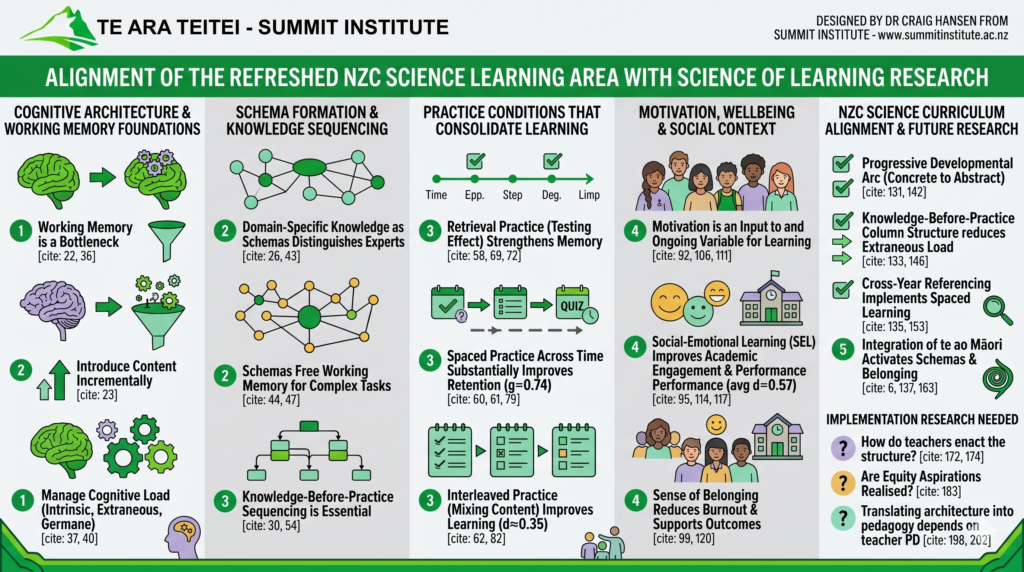
Here is how each of the five core concepts from the infographic translates into a practical science classroom scenario, showing the difference between a high-cognitive-load approach and a science-of-learning approach.
1. Cognitive Architecture & Working Memory Foundations
- The Scenario: Teaching 13-year-olds the difference between elements, compounds, and mixtures.
- Low-Impact Approach: The teacher hands out a complex text filled with dense chemical formulas and asks students to write a summary report on their first day of the unit. Students quickly become overwhelmed, look confused, and disengage because their working memory is overloaded.
- The Impact on Learning: By managing cognitive load and introducing content incrementally, the teacher instead presents just one concept first: pure elements using visual color-coded blocks. Once that is solid, they introduce compounds, and finally mixtures. Breaking it down respects the working memory bottleneck, ensuring students actually process and store the foundational definitions.
2. Schema Formation & Knowledge Sequencing
- The Scenario: A high school physics class learning about electrical circuits.
- Low-Impact Approach: Students are immediately given wires, bulbs, and batteries and told to “discover how a circuit works” through open inquiry. Without existing mental frameworks, they spend the hour frustrated, guessing blindly.
- The Impact on Learning: Following knowledge-before-practice sequencing, the teacher first uses a water-pipe analogy to build a basic “schema” (mental map) of voltage, current, and resistance. When students later do the practical lab, they aren’t guessing; they are mapping the physical wires directly onto their existing mental schemas. This frees up working memory to predict outcomes and analyze errors critically.
3. Practice Conditions That Consolidate Learning
- The Scenario: Preparing students for an end-of-term biology assessment on genetics.
- Low-Impact Approach: The teacher finishes the genetics topic a month early, moves on to ecology, and then gives students a massive, three-hour “cram session” study guide the day before the exam.
- The Impact on Learning: By utilizing spaced and retrieval practice, the teacher implements “low-stakes mini-quizzes” at the start of every week. They also use interleaved practice by mixing a couple of genetics questions into the current ecology homework. This continuous, varied retrieval forces the brain to repeatedly reconstruct the knowledge, strengthening neural pathways and ensuring long-term retention rather than temporary cramming.
4. Motivation, Wellbeing & Social Context
- The Scenario: A diverse general science class tackling a challenging chemistry unit on acids and bases.
- Low-Impact Approach: The teacher maintains a strict, impersonal environment focused purely on rote content delivery, ignoring student anxiety and treating mistakes as failures.
- The Impact on Learning: Recognizing that motivation is an ongoing variable and that a sense of belonging matters, the teacher structures collaborative group work where every student has a defined, achievable role. They frame mistakes as a natural part of scientific iteration. Because students feel socially safe and emotionally supported, their anxiety drops, their academic engagement increases, and they are much more willing to persist through difficult problem-solving.
5. NZC Science Curriculum Alignment & Future Research
- The Scenario: Designing a ecology unit that spans multiple year levels in a New Zealand school.
- Low-Impact Approach: Year 9 and Year 10 teachers operate in silos, teaching disconnected topics without checking what students already know or how it connects to their local environment.
- The Impact on Learning: Applying the progressive developmental arc and integration of te ao Māori, teachers design a curriculum where Year 9 students learn about local ecosystems by studying the whakapapa (interconnectedness) of a local wetland. By Year 10, the curriculum revisits this with “cross-year referencing,” advancing to abstract concepts like energy transfer and human impacts. Integrating indigenous frameworks activates familiar cultural schemas, giving local students an immediate sense of belonging and relevance that anchors the abstract science.
How the New NZC Science Curriculum Refresh Aligns with the Science of Learning
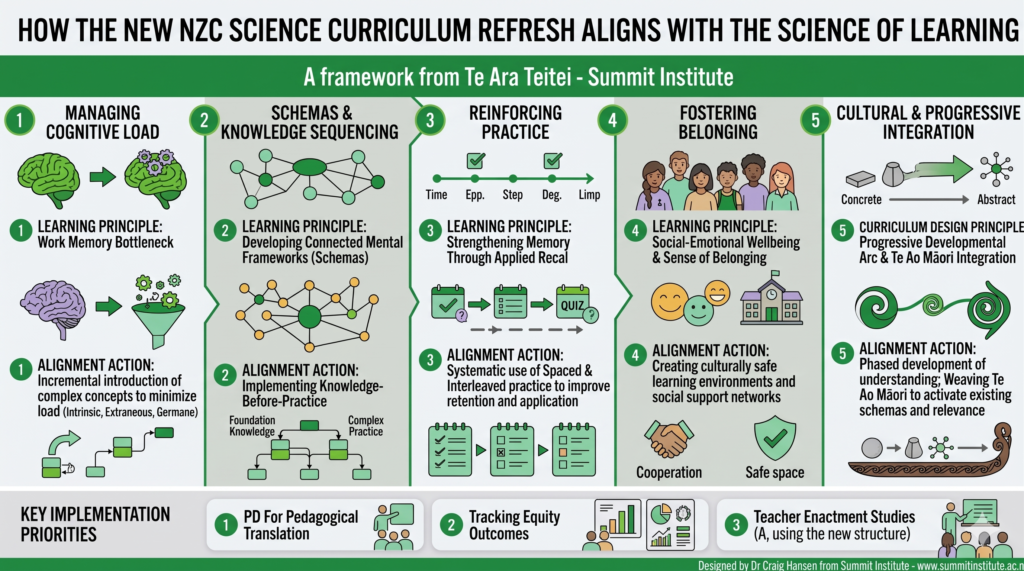
For curriculum and AI for Education training for schools and boards, teacher-only days, and cluster meetings, reach out through our website or contact Dr. Craig Hansen directly, New Zealand’s leading AI trainer.