Most principals already know AI matters. The harder question is knowing where to start — and how to lead well when the ground keeps shifting.
Dr. Craig Hansen has worked alongside more than 1,000 schools across New Zealand on AI in education. In that time, one thing has become clear: AI readiness isn’t a single moment. It’s a progression — and knowing which stage your school is at changes everything about where you focus first.
This article maps what genuine AI readiness looks like for principals and senior leadership teams, and outlines a practical, culturally responsive approach to building an AI strategy for schools that is sustainable, safe, and grounded in your community’s values.
Why AI strategy for schools is now a leadership issue, not just a tools issue
AI has moved fast. Tools that generate lesson plans, translate communications, write reports, and support differentiated learning are already in use across New Zealand classrooms — often without any school-wide guidance in place.
That gap between what’s happening and what’s been planned for is where most schools find themselves right now.
Without a clear whole-school AI roadmap, individual teachers make their own decisions. Some will use AI brilliantly. Others will use it in ways that create risk — for assessment integrity, for student data, or for cultural responsiveness. The variation becomes the problem.
This is why AI is a principal’s issue. Not because you need to become a technology expert, but because setting direction, managing risk, and building shared practice is leadership work.
“Came in today thinking I was confident in what my school and I knew about AI. I was extremely impressed and ecstatic on what I can take away to the other leaders from my school.”
— Senior leader, Waikato school
What AI readiness for principals actually involves
Genuine AI readiness for principals doesn’t mean having every answer. It means having enough clarity to make good decisions, enough structure to manage risk, and enough courage to lead while things are still evolving.
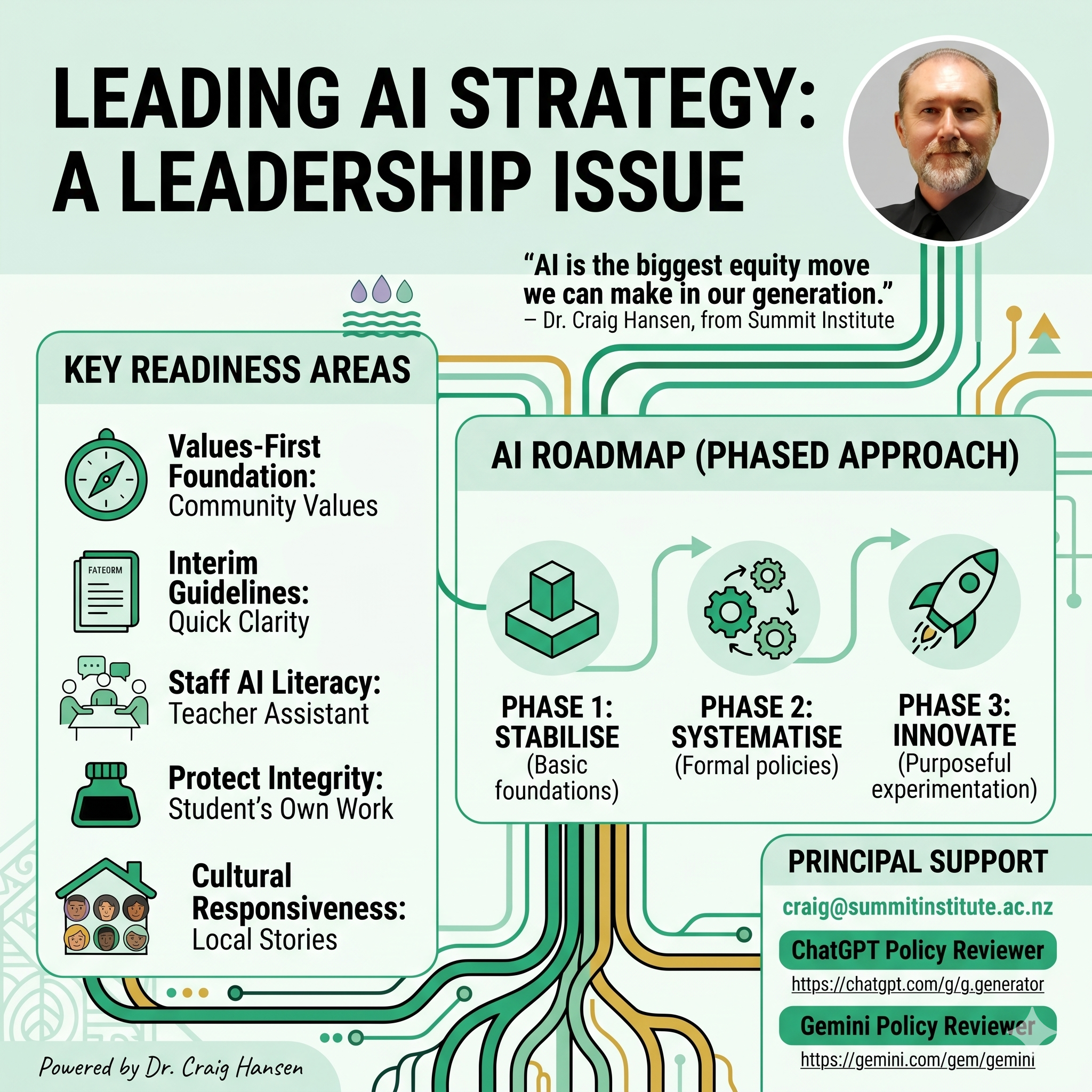
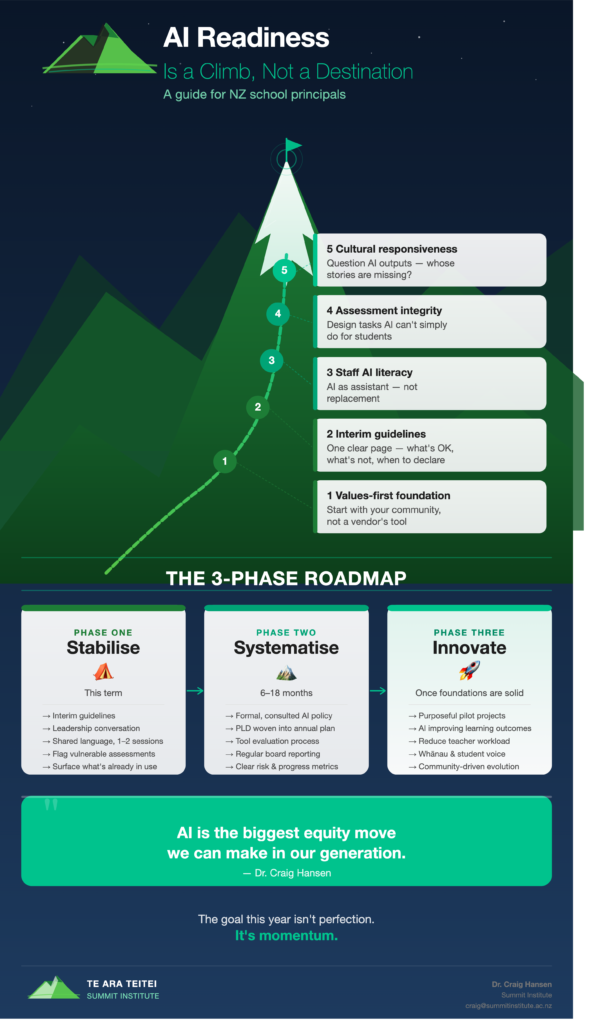
In practice, it involves five interconnected areas:
1. A values-first foundation
Before selecting any tool or writing any policy, the most important question is: what does AI mean for this school, this community, and these ākonga?
Your existing strategic plan, graduate profile, and community values are the right starting point — not a vendor’s recommendations. Principals who anchor AI decisions in school values create more coherent, defensible, and culturally responsive approaches than those who chase every new tool.
2. Interim guidelines your staff can actually use
A full AI policy takes time. Interim guidelines don’t. A single clear document — one page is enough — can answer the questions teachers are already asking: When can students use AI? When is it not allowed? When must it be declared?
These guidelines don’t need to be perfect. They need to be clear, practical, and communicated. They can evolve as national guidance from the Ministry of Education develops and as your school’s experience grows.
3. Staff AI literacy that reduces anxiety, not just adds tasks
Many teachers are curious but anxious. Others are already using AI in ways their principal doesn’t know about. Building staff AI literacy means creating a safe space for learning together — not mandating a tool or running a one-off session and considering it done.
The frame that works best across New Zealand schools is AI as assistant, not replacement. That framing keeps the focus on teaching, learning, and relationships — not on whether AI will take someone’s job.
4. Assessment authenticity and integrity protected from day one
NZQA’s expectations around assessment authenticity are clear: evidence of learning must be the student’s own. The questions for schools are practical ones — which assessments are most vulnerable? How do you design tasks that stay authentic when AI exists? How do you communicate clearly with ākonga and whānau?
The schools that handle this well don’t ban AI entirely. They design for it — building in more oral, in-class, and process-based evidence, and being explicit with students about where AI help is acceptable and where it isn’t.
5. Cultural responsiveness embedded, not added on
AI tools are not neutral. They carry the assumptions, biases, and cultural blind spots of the data they were trained on. For New Zealand schools — especially kura serving Māori, Pacific, and diverse communities — this matters enormously.
Leading AI responsibly in schools means actively questioning what AI produces: whose stories are present? Whose are missing? How do outputs need to be adapted to reflect your ākonga and their communities? This isn’t extra work — it’s the same culturally responsive lens your staff already bring to every other aspect of teaching.
What a practical whole-school AI roadmap looks like
AI readiness isn’t a destination — it’s a direction. The goal for most schools this year isn’t perfection. It’s momentum: moving from reactive to intentional, and from individual to whole-school.
A practical whole-school AI roadmap typically moves through three phases:
Phase one — Stabilise
Get the basics in place this term. Interim guidelines. A leadership conversation about values and risk. One or two staff sessions to surface what’s already happening and build shared language. Early identification of which assessments need attention.
Phase two — Systematise
Over the next six to eighteen months, move from interim to formal. A consulted, adopted AI policy. Ongoing PLD woven into your annual plan. Clear processes for evaluating AI tools before they’re used with students. Regular board reporting on AI-related risk and progress.
Phase three — Innovate
Once foundations are solid, create space for purposeful experimentation. Pilot projects where AI genuinely improves learning outcomes, reduces teacher workload, or strengthens community connections. Student and whānau voice built into how AI use is reviewed and evolved.
“I want to run whole staff PLD on this and give all our teachers the opportunity to learn what I have today.”
— Senior leader, South Auckland school
The Ministry of Education guidance context
Ministry of Education guidance on AI is developing, and schools are expected to respond to it — even while the detail is still emerging. What’s already clear from Ministry signals is that schools should:
- Have considered AI risks and opportunities at a governance and leadership level.
- Have some form of acceptable use guidance for staff and students.
- Be protecting assessment authenticity in line with NZQA expectations.
- Be actively considering student wellbeing and data privacy in relation to AI tools.
Principals who wait for a definitive national policy before acting are likely to find themselves significantly behind. The more practical approach is to build interim structures now that can be refined as guidance matures.
How I support principals on AI strategy
If you are a principal or member of a senior leadership team, you don’t need a 50-page policy or a generic professional learning day. You need practical, tailored support that honours your school’s context, culture, and constraints.
I work with principals to:
- Clarify your school’s AI vision and values.
- Map where AI is already showing up — with and without school-wide guidance.
- Identify your top risks and practical opportunities.
- Co-design interim guidelines and a staged AI roadmap your leadership team can actually implement.
- Align AI strategy with your existing annual and strategic plans.
- Design and lead staff PLD that builds confidence, not anxiety.
To explore how I can support your school, contact me at craig@summitinstitute.ac.nz to schedule an introductory chat.
You can also generate a draft AI policy for your school or review an existing one using the tools I’ve developed specifically for New Zealand educators:
- ChatGPT version: https://chatgpt.com/g/g-9RWHgaCa5-dr-craig-s-ai-policy-reviewer-upload-generator
- Gemini version (for Google schools): https://gemini.google.com/gem/1vxfFeGPs93btyPamcIW-IypGyhzarFoZ
Both tools generate a draft policy AND review an existing one — a practical first step your school can take today.
“AI is the biggest equity move we can make in our generation.”
— Dr. Craig Hansen, quoted by a tumuaki, Far North school