
Most schools quietly believe that inclusion is something that happens for a small group of students: the ones with an Individual Education Plan, the ones who see the visiting specialist, the ones with a teacher aide sitting beside them. Dr. Craig Hansen, founder of Summit Institute and a specialist who has trained more than 1,000 schools across Aotearoa New Zealand, argues that this belief is the very thing quietly excluding everybody else.
It’s an understandable mistake. But it sets schools up to always be playing catch-up, with the most stretched staff member in the building becoming the de facto specialist for everyone else’s planning. There is a different way to think about this — one that scales, survives staff turnover, and actually reduces workload rather than adding to it.
“AI is the biggest equity move we can make in our generation.” — Dr. Craig Hansen, quoted by a principal, Far North school
The same equity instinct behind that line applies just as directly here, with or without AI in the picture.
What inclusion actually means
The New Zealand Curriculum Framework is clear on this point: inclusion means every learner’s identity, language, ability, and culture is recognised, and the barriers in their way are designed out from the start — not patched in afterwards.
That’s a meaningfully different job to the one most schools think they’re doing. If inclusion is what we do for the five students in a class who have additional or diagnosed needs, the system will always be reactive. If inclusion is how a school designs every lesson, every policy, and every classroom, it scales across a whole staff and survives the departure of any one specialist.
For schools in Aotearoa, this sits inside a culturally responsive frame — doing right by learners with pono and aroha, so that every ākonga sees themselves belonging here, not just coping here.
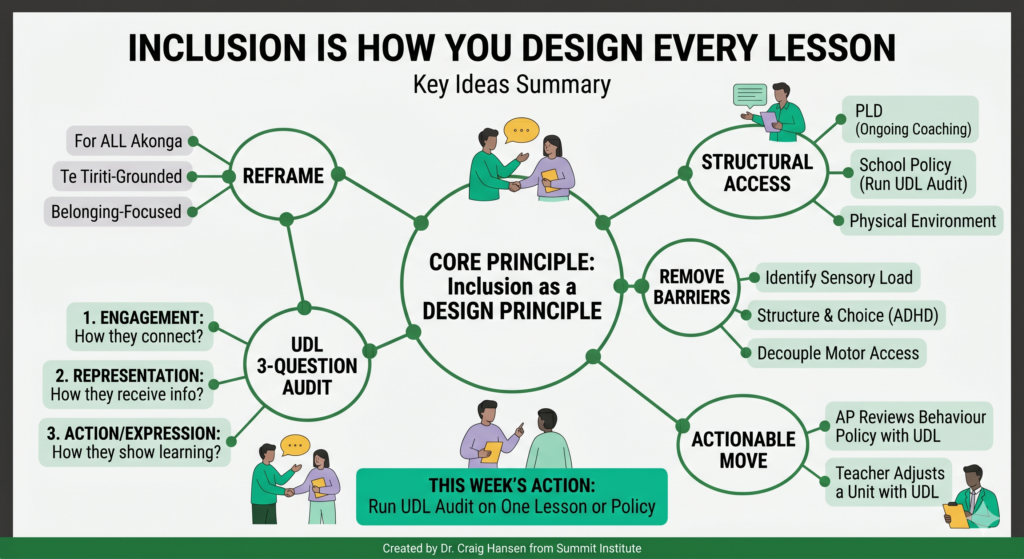
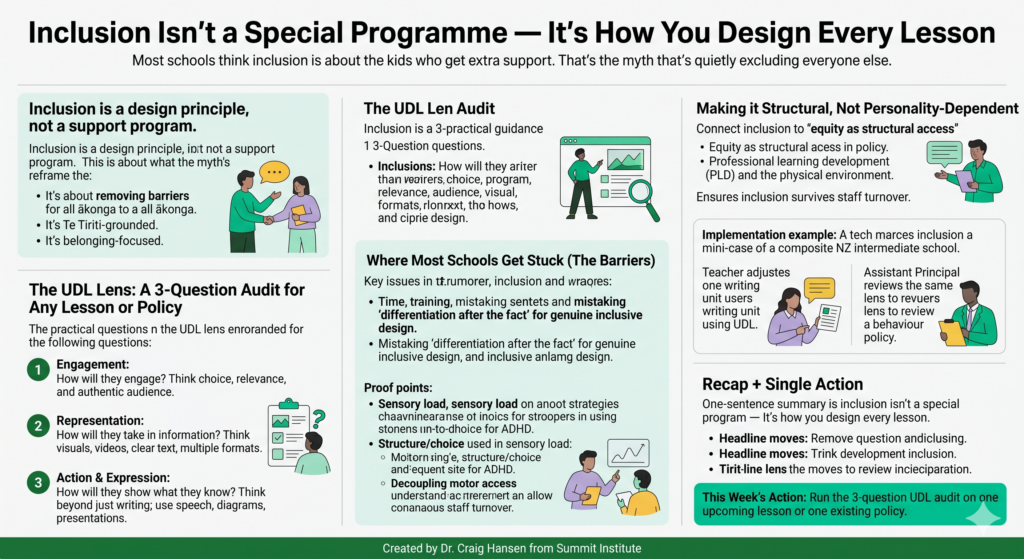
The single idea worth holding onto: inclusion is a design principle, not a support programme.
A three-question audit you can run on anything
Here is the part that makes this practical rather than aspirational. You don’t need a new policy document to start. You need three questions, borrowed from a framework called Universal Design for Learning (UDL).
How will they engage? Not every student is motivated the same way. A lesson that only works for compliant, intrinsically motivated students isn’t designed for your real class — it’s designed for an imaginary one where everyone is the same and everything always works.
How will they take in the information? If the only format on offer is “read this, then write about it,” that’s a barrier built in for plenty of capable learners before the lesson has even started.
How will they show what they know? Writing an essay is not the only way to demonstrate understanding. A spoken explanation, a diagram, a recorded video, something creative, or a piece of physical demonstration can all provide evidence of learning through a different pathway.
A useful rule of thumb follows from this: if only one type of student can succeed at a task, the task is the barrier — not the student.
What this looks like in a real classroom
Picture a Year 9 social studies unit on local government. Run through the three questions, the unit might look like this: students choose the real local issue that matters most to them (engagement); the council process is explained through a diagram and a short video rather than a textbook page (representation); and for the assessment, some students write a report while others record a two-minute pitch to camera, both assessed against the same success criteria (action and expression).
Same learning outcome. Three different ways to open the door, instead of one.
Two things that quietly sink inclusive practice
In practice, two patterns undermine inclusive teaching almost every time.
The first is treating it as a time problem rather than a structural one. Designing a unit well does take longer than recycling last year’s version — but the fix isn’t redesigning everything at once. It’s starting with one unit, for one term, for one team, and revisiting it from there.
The second, bigger problem is relying on one brilliant SENCO or learning support coordinator to carry inclusion for the whole staff. That isn’t inclusion — it’s outsourcing. Real inclusive practice needs every teacher holding the baseline knowledge, not one specialist holding all of it.
Concrete, low-cost moves any teacher can make
Some of the most effective adjustments require no diagnosis, no referral, and no waiting for a specialist to arrive.
Unmanaged sensory load — lighting, noise, clutter — is often a hidden barrier that a classroom teacher can fix directly, and a school leader can audit in five minutes. For students who experience ADHD, structure and choice tend to work far better than being asked to simply try harder; visual schedules and task orders students can control make a genuine difference. And for handwriting-heavy tasks, separating the thinking from the physical act of writing — letting a student dictate, type, or use a scribe — often reveals a student who understood everything but couldn’t get it down on paper fast enough.
None of these require a referral. They require a teacher who knows how to look. The question isn’t “does this student have a diagnosis?” It’s “what’s actually getting in the way right now?”
Making it stick: three places to build inclusion into the structure
Good intentions don’t survive a staff changeover. Structure does. There are three places where inclusion needs to be built in so it doesn’t depend on one person.
Policy. When your school reviews a behaviour, attendance, or assessment policy, run it through the same three UDL questions you’d run a lesson through. A detention policy that assumes every student processes consequences the same way is a policy with a built-in barrier.
Professional learning. A one-off workshop, ticked off and filed away, isn’t enough. Inclusive practice needs ongoing, feedback-based coaching — someone watching real lessons and giving real feedback, not a slide deck delivered once a year.
Physical environment. Lighting, acoustics, and layout aren’t decoration — they’re access. A new build or refurbishment that doesn’t have sensory-aware design standards built in locks in barriers for the next twenty years.
The rule of thumb here: treat inclusion as equity of access to learning, not a value statement on the wall. Equity means a student’s ability to participate doesn’t depend on luck — on which teacher, which classroom, or which year they happen to land in.
One school, two roles, the same lens
A useful way to see how this scales is to picture a composite intermediate school. A Year 7 teacher planning a writing unit builds in choice from the start — written, recorded, and visual storyboard formats, all assessed against the same success criteria. One student who had struggled with writing all year produces the strongest work of the term, spoken into a recording and then transcribed.
At the same time, the school’s AP is reviewing the behaviour management policy. Instead of assuming every student responds the same way to a warning system, she runs the same three UDL questions over the policy: how do students differentiate their engagement with consequences, how is the expectation communicated, and how do students show they’ve understood what was being asked of them? The revised policy adds visual reminders alongside verbal cues — a small change that reduces repeated incidents across several classrooms, not just one.
Different roles, same lens. That’s what makes inclusion scalable across a whole staff, rather than living inside one teacher’s head or one staff member’s portfolio.
The single action for your next leadership meeting
Pick one lesson, one policy, or one learning space. Run it through the three questions — engagement, representation, expression — and bring what you find to your next leadership meeting.
That’s the whole starting point. Not a new policy, not a new programme, not a new specialist hire. Just three questions, asked consistently, by everyone.
About the author Dr. Craig Hansen is an AI in education specialist and founder of Summit Institute, a New Zealand private training provider. He works with teachers, school leaders and school boards across Aotearoa New Zealand — from primary through secondary — to develop practical, culturally responsive approaches to teaching, learning, and AI in education.
Want to bring this thinking into your next teacher-only day or leadership meeting? Contact to schedule an introductory chat with Dr. Craig Hansen, craig@summitinstitute.ac.nz.
If your school is also exploring how AI fits into safe, inclusive practice, Dr. Craig’s AI Policy Creator and Reviewer tools are available as a ChatGPT GPT (https://chatgpt.com/g/g-9RWHgaCa5-dr-craig-s-ai-policy-reviewer-upload-generator) and a Gemini Gem (https://gemini.google.com/gem/1vxfFeGPs93btyPamcIW-IypGyhzarFoZ).