
Business administration remains one of the most versatile and valuable qualifications you can pursue in 2026, offering pathways into virtually every industry and sector across New Zealand. Whether you're looking to launch your career, transition into management, or strengthen your existing skillset, courses in business admin provide the foundation for professional growth and organisational success. These qualifications equip learners with essential competencies in communication, financial literacy, technology, and strategic thinking that employers actively seek in today's competitive marketplace.
Understanding Business Administration Qualifications
Courses in business admin come in various formats and levels, designed to meet learners at different stages of their professional journey. The New Zealand Qualifications Framework (NZQA) structures these programmes to ensure consistent quality and industry relevance.
Certificate-Level Programmes
Entry-level qualifications typically start at Level 3, providing fundamental business skills suitable for those new to the workforce or changing career directions. These programmes cover essential administrative functions, basic accounting principles, and workplace communication.
The New Zealand Certificate in Business Administration and Technology Level 3 introduces learners to core business concepts whilst integrating modern digital tools. This combination proves increasingly valuable as organisations digitise their operations.
At Level 4, courses in business admin expand to include more sophisticated administrative responsibilities and introduce management concepts. The curriculum typically addresses:
- Advanced document preparation and information management
- Customer relationship strategies
- Financial record-keeping and reporting basics
- Project coordination and team support
- Technology integration across business processes

Diploma and Advanced Qualifications
Diploma-level programmes at Level 5 represent a significant step towards management and strategic roles. These qualifications delve into business analysis, operational planning, and decision-making frameworks that prepare graduates for supervisory and middle-management positions.
According to resources compiled by educational institutions, business administration studies encompass diverse specialisations including accounting, marketing, risk management, and entrepreneurship. This breadth allows learners to tailor their education towards specific career objectives.
| Qualification Level | Typical Duration | Career Outcomes | Key Focus Areas |
|---|---|---|---|
| Level 3 Certificate | 6-12 months | Administrative Assistant, Office Support | Basic operations, communication, digital literacy |
| Level 4 Certificate | 12-18 months | Senior Administrator, Team Coordinator | Advanced admin, project support, first-line supervision |
| Level 5 Diploma | 18-24 months | Operations Manager, Business Analyst | Strategic planning, financial management, leadership |
Core Competencies Developed Through Business Admin Courses
Courses in business admin develop a comprehensive skillset that transfers across industries and organisational contexts. Understanding these competencies helps prospective learners recognise the value these qualifications deliver.
Financial and Analytical Skills
Financial literacy stands as a cornerstone of business administration education. Learners develop capabilities in budgeting, financial reporting, cost analysis, and resource allocation. These skills prove essential whether managing departmental finances or supporting organisational decision-making.
Analytical thinking complements financial knowledge, enabling graduates to interpret data, identify trends, and recommend evidence-based solutions. In 2026, with business intelligence tools becoming increasingly accessible, the ability to translate data into actionable insights distinguishes effective administrators.
Communication and Stakeholder Management
Professional communication forms another critical component of courses in business admin. This extends beyond email etiquette to encompass:
- Presentation skills for conveying information to diverse audiences
- Negotiation techniques for managing supplier relationships and internal resources
- Conflict resolution strategies for maintaining productive workplace environments
- Cross-cultural communication in increasingly globalised business contexts
The New Zealand Certificate in Business First-Line Management Level 4 specifically addresses these interpersonal competencies alongside technical management skills.
Technology Integration
Modern courses in business admin recognise that digital proficiency is non-negotiable in contemporary workplaces. Curricula integrate various technology platforms and tools, from enterprise resource planning systems to customer relationship management software.
Cloud-based collaboration tools, project management applications, and data visualisation platforms feature prominently in practical learning activities. This technological grounding ensures graduates can contribute immediately upon entering the workforce.
Flexible Learning Options for Working Professionals
One significant advantage of pursuing courses in business admin in 2026 is the variety of delivery methods available. Accredited providers now offer learning formats that accommodate diverse circumstances and preferences.
On-Campus Learning
Traditional campus-based programmes continue to appeal to learners who value face-to-face interaction, structured schedules, and immediate access to instructors. This format suits those who thrive in collaborative environments and benefit from separating study from home or work settings.
Campus facilities often include business simulation labs, collaborative workspaces, and access to industry-standard software, providing hands-on experience with professional tools.
Online and Blended Approaches
Digital delivery has matured significantly, offering sophisticated learning platforms that rival in-person experiences. Quality online courses in business admin incorporate video lectures, interactive assignments, virtual group projects, and real-time discussions.
Blended learning combines the best of both approaches, typically featuring online content delivery with periodic in-person workshops or assessment sessions. This flexibility particularly benefits working professionals who cannot commit to regular campus attendance.
Explore study options to find delivery methods that align with your schedule and learning preferences.

Industry Recognition and Career Pathways
Courses in business admin accredited by NZQA carry significant weight with New Zealand employers. This recognition stems from rigorous quality assurance processes that ensure programmes meet industry standards and workplace requirements.
Employment Sectors and Opportunities
Business administration graduates find opportunities across virtually every sector of the economy. Common employment pathways include:
- Corporate environments in administrative, operational, or project support roles
- Government agencies requiring strong organisational and compliance capabilities
- Healthcare facilities managing patient services, records, and operational logistics
- Education institutions supporting academic delivery and student services
- Small-to-medium enterprises where administrators often wear multiple hats
According to research guides from business schools, business professionals benefit from understanding annual reports, company information, and market data when navigating career opportunities.
Progression and Specialisation
The structured nature of NZQA qualifications creates clear progression pathways. Completing a Level 3 certificate naturally leads to Level 4 studies, which in turn open diploma-level opportunities.
Beyond general business administration, learners can specialise in areas such as:
- Financial services, with dedicated programmes like the New Zealand Certificate in Financial Services Level 5
- Project management focusing on planning, execution, and stakeholder coordination
- Human resources emphasising recruitment, performance management, and workplace relations
- Operations management concentrating on process improvement and efficiency
Practical Skills for Real-World Success
Courses in business admin emphasise applied learning that translates directly to workplace performance. This practical orientation distinguishes quality programmes from purely theoretical approaches.
Problem-Solving and Decision-Making
Business administrators regularly encounter challenges requiring creative solutions within resource constraints. Effective programmes develop systematic problem-solving approaches:
- Situation analysis to understand root causes rather than symptoms
- Option generation considering multiple potential solutions
- Impact assessment evaluating consequences of different approaches
- Implementation planning translating decisions into actionable steps
These frameworks prove valuable whether addressing operational inefficiencies, customer complaints, or resource allocation dilemmas.
Documentation and Process Management
Professional documentation serves as the backbone of organisational memory and compliance. Courses in business admin teach learners to create, maintain, and improve various business documents including:
| Document Type | Business Purpose | Key Skills Developed |
|---|---|---|
| Procedures Manual | Standardise operations, train staff | Process mapping, clear instruction writing |
| Financial Reports | Track performance, support decisions | Data analysis, presentation clarity |
| Meeting Minutes | Record decisions, assign accountability | Active listening, concise summarisation |
| Project Plans | Coordinate activities, manage resources | Timeline creation, risk identification |
| Policy Documents | Establish guidelines, ensure compliance | Research, stakeholder consultation |
The New Zealand Diploma in Business Level 5 develops these capabilities through authentic assessment tasks that mirror workplace requirements.
Evaluating Quality in Business Administration Education
When selecting courses in business admin, understanding quality indicators helps ensure your investment delivers genuine value and industry recognition.
Accreditation and Standards
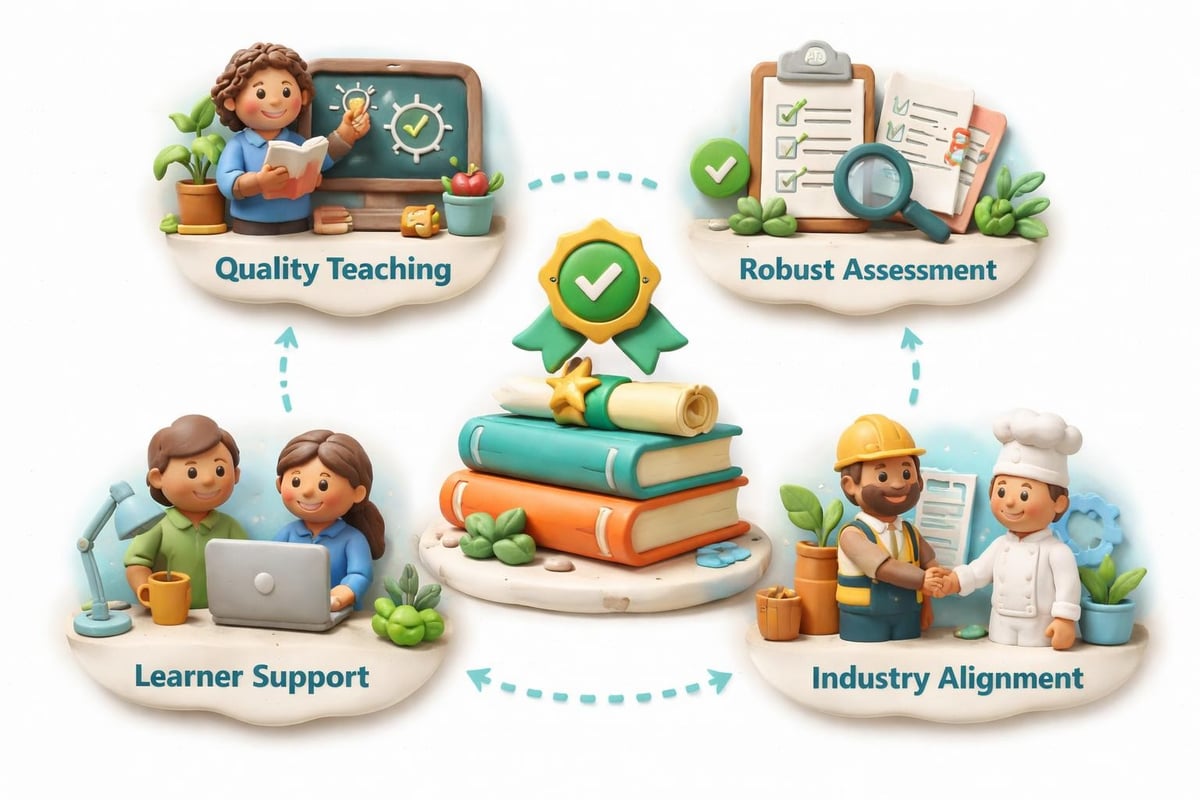
NZQA accreditation represents the gold standard for New Zealand qualifications. NZQA accreditation indicates the provider consistently meets high quality benchmarks across teaching, assessment, and learner support.
This accreditation ensures:
- Nationally recognised credentials that employers understand and value
- Quality-assured curriculum aligned with industry needs
- Robust assessment that genuinely measures competency
- Learner protection through regulated standards and accountability
Resources like guides on evaluating credible sources offer useful frameworks for assessing educational providers beyond accreditation status.
Support Services and Resources
Quality providers invest in comprehensive learner support extending beyond classroom instruction. When evaluating courses in business admin, consider:
- Academic assistance including tutoring, writing support, and study skills workshops
- Library and research access to business databases and reference materials
- Career guidance connecting qualifications to employment opportunities
- Technology support ensuring smooth access to digital learning platforms
- Pastoral care addressing personal circumstances that affect study
These services significantly impact completion rates and learning outcomes, particularly for learners balancing education with work and family commitments.
Current Trends Shaping Business Administration Education
Courses in business admin evolve continuously to reflect changing workplace realities and emerging business practices. Understanding these trends helps prospective learners select relevant, forward-looking programmes.
Digital Transformation and Automation
Business process automation increasingly handles routine administrative tasks, shifting the administrator's role towards oversight, exception handling, and strategic support. Quality courses in business admin prepare learners for this evolution by emphasising:
- Systems thinking and process optimisation
- Data interpretation and reporting
- Technology adoption and change management
- Value-added activities requiring human judgement
This technological integration extends to artificial intelligence applications in business contexts. Learners interested in cutting-edge developments might explore AI in education programmes to understand how these tools reshape professional practices.
Sustainability and Ethical Business Practices
Environmental, social, and governance considerations now feature prominently in business operations across sectors. Modern courses in business admin incorporate sustainability principles, ethical decision-making frameworks, and stakeholder responsibility concepts.
This reflects employer expectations that business professionals understand their organisation's broader impact and contribute to responsible practices.
Remote and Hybrid Work Management
The normalisation of distributed teams fundamentally changes administrative requirements. Contemporary programmes address:
- Virtual team coordination across time zones and digital platforms
- Digital document management replacing physical filing systems
- Remote communication maintaining engagement without face-to-face interaction
- Performance monitoring in asynchronous work environments
- Cybersecurity awareness protecting organisational information
These capabilities prove essential as flexible work arrangements become permanent features of New Zealand's business landscape.
Making the Investment: Costs and Returns
Pursuing courses in business admin represents both a financial and time investment. Understanding the costs involved and potential returns helps inform decision-making.
Programme Costs and Funding Options
Tuition fees vary based on qualification level, programme duration, and provider. Certificate-level courses typically cost less than diploma programmes, reflecting the scope and depth of content covered.
Prospective learners should investigate:
- Student loan eligibility for approved qualifications
- Employer sponsorship particularly when qualifications enhance current role performance
- Scholarship opportunities offered by institutions or industry organisations
- Payment plans spreading costs across the programme duration
Contact details for specific providers allow you to obtain accurate fee information and discuss funding options tailored to your circumstances.
Career Advancement and Salary Impact
Financial returns from courses in business admin manifest through expanded employment opportunities, salary increases, and promotion potential. While individual outcomes vary based on numerous factors, business qualifications consistently demonstrate positive employment impacts.
Beyond monetary benefits, these qualifications deliver:
- Professional confidence from validated competency
- Career flexibility through transferable skills
- Networking opportunities connecting with peers and instructors
- Personal satisfaction from achieving educational goals
Specialised Pathways Within Business Administration
Whilst core courses in business admin provide broad foundations, many learners benefit from specialised pathways aligned with specific career interests or industry sectors.
First-Line Management
Supervisory and team leadership roles require distinct competencies beyond individual contribution. Programmes targeting first-line managers develop skills in:
- Performance management and coaching
- Resource allocation and scheduling
- Quality assurance and compliance monitoring
- Health and safety responsibilities
- Change implementation at team level
These capabilities bridge technical expertise and strategic management, positioning graduates for progression into senior leadership.
Technology-Enhanced Administration
Digital business environments demand administrators who can leverage technology strategically. Specialised courses in business admin might emphasise:
- Enterprise system administration
- Data analytics and business intelligence
- Digital marketing and social media management
- E-commerce operations
- Cybersecurity and information governance
The New Zealand Certificate in Business Administration and Technology Level 4 exemplifies this technology-integrated approach to business education.
Industry-Specific Applications
Some courses in business admin cater to particular sectors with unique requirements. Healthcare administration differs substantially from construction industry management, for example. Sector-specific programmes incorporate:
- Regulatory frameworks governing the particular industry
- Terminology and processes specific to sector operations
- Stakeholder relationships characteristic of the field
- Compliance requirements unique to the industry context
This specialisation accelerates workplace readiness and demonstrates commitment to prospective employers in target sectors.
Assessment Methods in Modern Business Programmes
Understanding how courses in business admin measure learning helps prospective students prepare for programme requirements and appreciate the rigour involved.
Portfolio-Based Assessment
Competency demonstration often occurs through portfolios compiling evidence of workplace application or simulated business activities. This assessment approach values:
- Authentic tasks reflecting real job requirements
- Integration of multiple skills simultaneously
- Contextualised problem-solving
- Professional presentation and documentation
Portfolios allow learners to showcase capabilities developed progressively throughout the programme rather than relying solely on final examinations.
Project Work and Case Studies
Applied projects challenge learners to analyse business situations, develop solutions, and justify recommendations. Case studies might involve:
- Organisational restructuring proposals
- Process improvement initiatives
- Market entry strategies
- Financial performance analysis
- Change management plans
These assessments develop critical thinking and strategic perspective alongside technical skills, preparing graduates for complex workplace challenges.
Workplace Integration
Many courses in business admin incorporate work-based components where learners apply concepts in actual employment settings. This approach benefits:
- Employed learners who can immediately implement learning
- Job seekers who gain practical experience enhancing employability
- Employers who see direct organisational benefits from employee development
Assessment in these contexts often involves supervisor verification of workplace performance against qualification standards.
Continuing Professional Development Beyond Initial Qualifications
Completing courses in business admin marks the beginning rather than the end of professional learning. The business environment evolves continuously, requiring ongoing skill development.
Micro-Credentials and Short Courses
Targeted learning through micro-credentials allows professionals to update specific capabilities without committing to full qualifications. These might address:
- Emerging technologies affecting business operations
- New regulatory requirements
- Contemporary management approaches
- Specialised software or platforms
These compact programmes complement existing qualifications, maintaining relevance throughout career progression.
Professional Associations and Networks
Industry bodies offer resources, networking opportunities, and professional development activities for business administrators. Membership provides:
- Access to current business research and publications
- Professional networking events
- Mentoring relationships
- Industry updates and trend analysis
These connections extend learning beyond formal education and support career advancement through relationship building.
Cross-Disciplinary Learning
Broadening expertise beyond pure business administration enhances versatility and problem-solving capability. Professionals might explore complementary areas such as:
- Financial services and investment
- Human resource management
- Marketing and customer experience
- Information technology and systems
- Sustainability and corporate responsibility
This diverse knowledge base positions administrators as strategic contributors rather than purely operational support.
Business administration qualifications provide versatile foundations for career success across industries, delivering practical skills that employers value and pathways for ongoing professional growth. Whether you're beginning your career journey or seeking to formalise existing experience, Summit Institute offers NZQA-accredited courses in business admin with flexible delivery options tailored to working professionals. Explore the range of nationally recognised qualifications designed to support your career aspirations and professional development goals.