AI is arriving in New Zealand classrooms faster than most schools can write policy for it. But the question schools ask most often — “is our AI use safe?” — isn’t the only question that matters. Just as important is: whose knowledge, whose language, and whose worldview is shaping the answers AI gives our students?
Dr. Craig Hansen, founder of Summit Institute, has trained more than 1,000 schools across Aotearoa New Zealand on AI in education. One line comes up again and again in his sessions, quoted back to him by principals and teachers alike: “AI is the biggest equity move we can make in our generation.” That equity promise only holds if the AI tools schools use — and the way staff are taught to use them — are genuinely culturally responsive.
“AWESOME TO HAVE A CULTURAL RESPONSIVE PERSPECTIVE ON IT TOO.” — Staff member, Auckland school, recent AI workshop attendee
Why AI in schools is a cultural responsiveness issue, not just a technical one
Most AI conversations in schools start with logistics: which tool, which policy, which age group. Those questions matter. But large language models are trained overwhelmingly on text written in English, from Western sources, reflecting Western norms of argument, structure and “correctness.” When a Year 7 class in Northland or a kura in the Far North uses a general-purpose AI tool for the first time, the tool doesn’t arrive neutral. It arrives carrying assumptions.
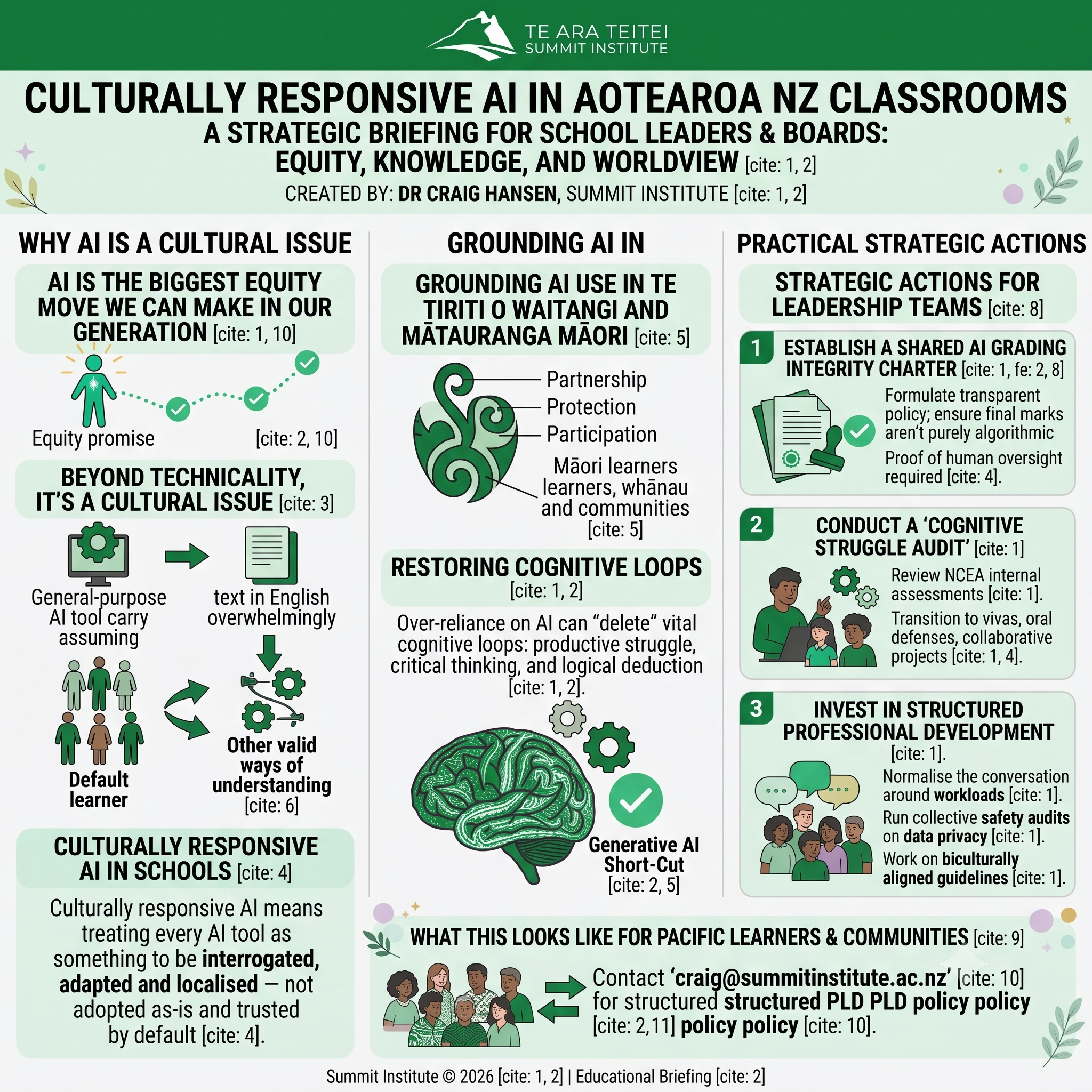
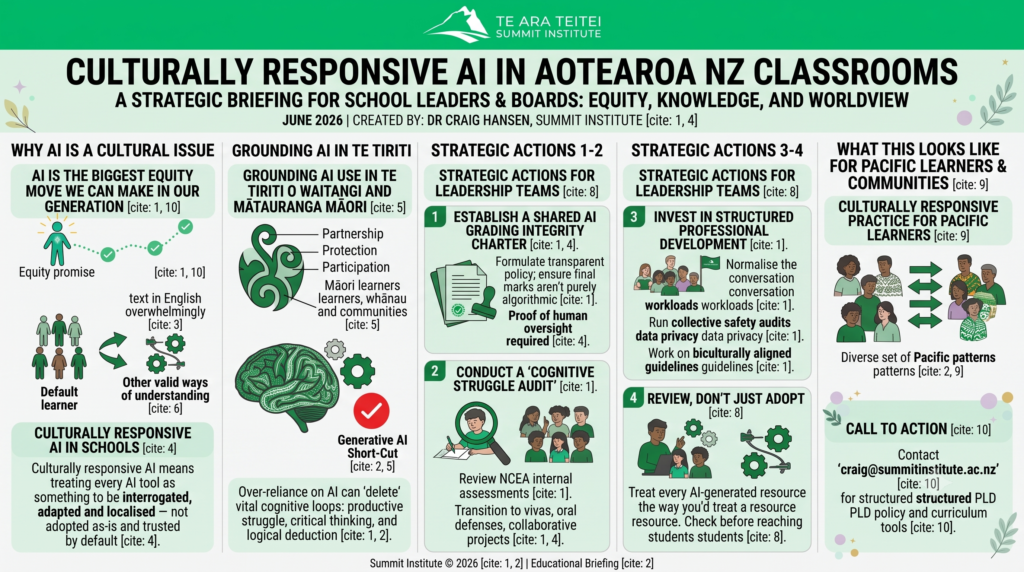
That’s not a reason to avoid AI. It’s a reason to teach it deliberately. Culturally responsive AI in schools means treating every AI tool as something to be interrogated, adapted and localised — not adopted as-is and trusted by default.
Grounding AI use in Te Tiriti o Waitangi and mātauranga Māori
Any credible AI strategy for Aotearoa New Zealand schools has to be grounded in Te Tiriti o Waitangi. That means schools going beyond “does this AI tool work” to ask “does this AI tool honour partnership, protection and participation for Māori learners, whānau and communities?”
Mātauranga Māori is not an inconvenient variable to bolt onto an AI policy. It is a knowledge system in its own right, and AI-generated content will not reflect it accurately unless staff are trained to recognise the gap and know how to fill it. Practical examples schools are already grappling with:
- AI-generated reo Māori content that is grammatically plausible but culturally hollow.
- Kaupapa Māori concepts flattened into English equivalents that lose their meaning.
- Local histories and pūrākau replaced with generic, homogenised versions when a teacher asks AI to “write a story about the local area.”
None of this means avoiding AI in kaupapa Māori or bilingual contexts. It means building the professional judgement to catch it, correct it, and — where appropriate — bring mana whenua and local expertise into the review process rather than relying on the AI tool alone.
Avoiding bias: whose knowledge and language shapes AI outputs
Bias in AI isn’t always obvious, and it rarely announces itself. It shows up as:
- Reading levels calibrated to a “default” learner who doesn’t reflect your roll.
- Assessment feedback that rewards a narrow, Western essay structure over other valid ways of showing understanding.
- Examples, names and contexts that default to Pākehā, urban, or American norms unless a teacher actively redirects them.
The fix isn’t to distrust AI wholesale. It’s to build staff capability to notice bias and correct for it — the same critical literacy schools already teach for any other source of information. Equity, bias and fairness need to sit inside AI PLD from day one, not as an afterthought once a tool is already embedded in daily practice.
“Hei Manaaki is a revolutionary tool that could be unbelievably helpful for new teachers, overseas teachers, and supporting all of us educators to be better practitioners of culturally responsive practice.” — Staff member, Bay of Plenty school, recent AI workshop attendee
Practical steps for culturally responsive AI policy and PLD
Schools don’t need a perfect answer before they start. They need a starting structure. In Craig’s work with school leaders and boards, four steps consistently make the biggest difference:
- Name culturally responsive AI use explicitly in your policy. Don’t leave it implied. State that AI-generated content involving Māori concepts, te reo, or local history must be checked against appropriate cultural expertise before use.
- Build critical AI literacy into PLD, not just tool training. Staff need practice spotting when an AI output is generic, biased, or culturally thin — not just practice using the tool.
- Involve whānau and community voice where AI touches culturally significant content. This is especially important for storytelling, local history projects, and communications home.
- Review, don’t just adopt. Treat every AI-generated resource the way you’d treat a resource from an unfamiliar publisher — check it before it reaches students.
This is where a well-built AI policy earns its keep. Dr. Craig Hansen’s AI Policy Creator and Reviewer helps schools draft and review governance policy that includes exactly this kind of culturally responsive safeguard, and is available in two versions so it fits whichever platform your school already uses:
- ChatGPT version: Dr. Craig’s AI Policy Reviewer & Generator
- Gemini version: AI Policy Creator and Reviewer Gem
For curriculum and assessment teams, the NZ Refreshed Curriculum Rubric Maker generates Ministry of Education-aligned rubrics directly from your teaching sequence statements — a useful companion when you’re checking that AI-supported assessment design still reflects your school’s cultural and curriculum priorities.
What this looks like for Pacific learners and communities
Culturally responsive AI use in New Zealand schools can’t stop at Te Tiriti and mātauranga Māori, important as that foundation is. Pacific learners make up a significant and growing share of many NZ rolls, and the same critical questions apply: does this AI-generated content reflect Pacific ways of knowing, storytelling and community structure, or does it default to a generic, disconnected version?
Practical, achievable steps here include:
- Checking AI-generated examples and case studies for Pacific representation, not just inclusion as an afterthought.
- Involving Pacific staff and community members in reviewing AI-supported content for cultural accuracy, the same way you would for Māori content.
- Being alert to AI’s tendency to flatten distinct Pacific nations and cultures into a single generic “Pacific” category.
Culturally responsive AI use isn’t a box to tick once and forget.
Culturally responsive AI use isn’t a box to tick once and forget. It’s an ongoing professional practice — one best built through structured PLD, not left to individual goodwill. Dr. Craig Hansen works with teachers, school leaders and school boards across Aotearoa New Zealand to design AI PLD and policy that is genuinely culturally responsive, safe, and practical, from primary through secondary.
“I love how it challenges our thinking and I love the inclusivity / cultural lens. And the reassurance of safety. Excellent engagement and resources unpacking how to get the best from AI.” — Staff member, Bay of Plenty school, recent AI workshop attendee
“AI is the biggest equity move we can make in our generation.” — Dr. Craig Hansen, quoted by a principal, Far North school
If your school or Kāhui Ako wants to build a culturally responsive approach to AI — from policy through to classroom practice — contact craig@summitinstitute.ac.nz to schedule an introductory chat. Or start today with the free AI Policy Creator and Reviewer and the NZ Refreshed Curriculum Rubric Maker linked above.
About the author Dr. Craig Hansen is an AI in education specialist and founder of Summit Institute, a New Zealand private training provider. He works with teachers, school leaders and school boards across Aotearoa New Zealand — from primary through secondary — to develop practical, culturally responsive approaches to AI in education.