Dr. Craig Hansen, founder of Summit Institute, a New Zealand private training provider, has worked with more than 1,000 schools across Aotearoa on AI in education — and assessment authenticity is the question he hears most often, from teachers, principals, and school boards alike. It sits at the intersection of everything schools are trying to balance: innovation and integrity, efficiency and equity, teacher professional judgement and institutional accountability.
This article is for anyone in a New Zealand school who needs to understand what assessment authenticity means in an AI-enabled world — and what to do about it.
Why assessment authenticity is the sharpest AI question schools face
AI didn’t create the challenge of assessment authenticity. Schools have always had to design tasks that genuinely reveal what students know and can do. But AI has made that challenge more urgent, more visible, and harder to ignore.
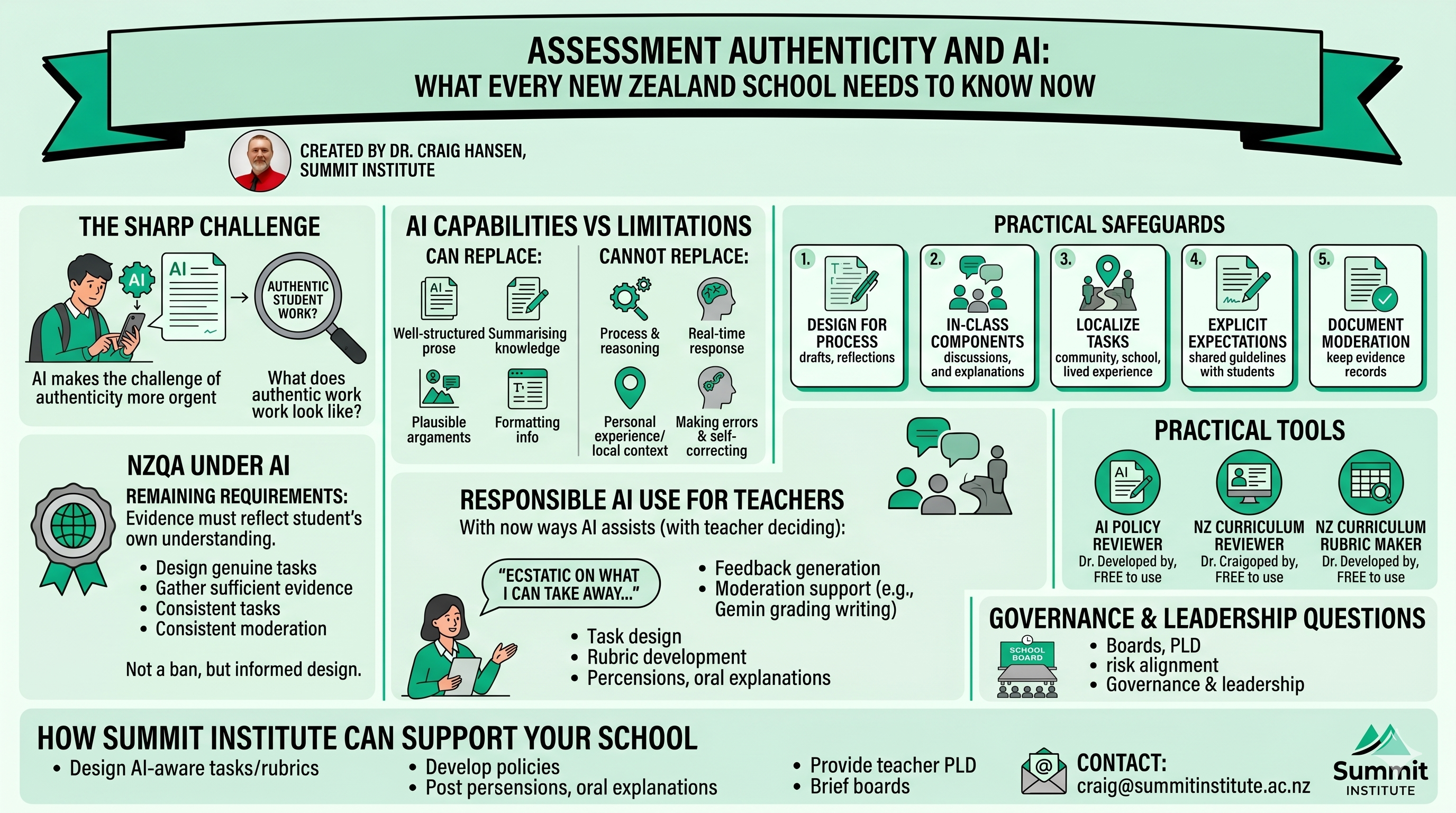
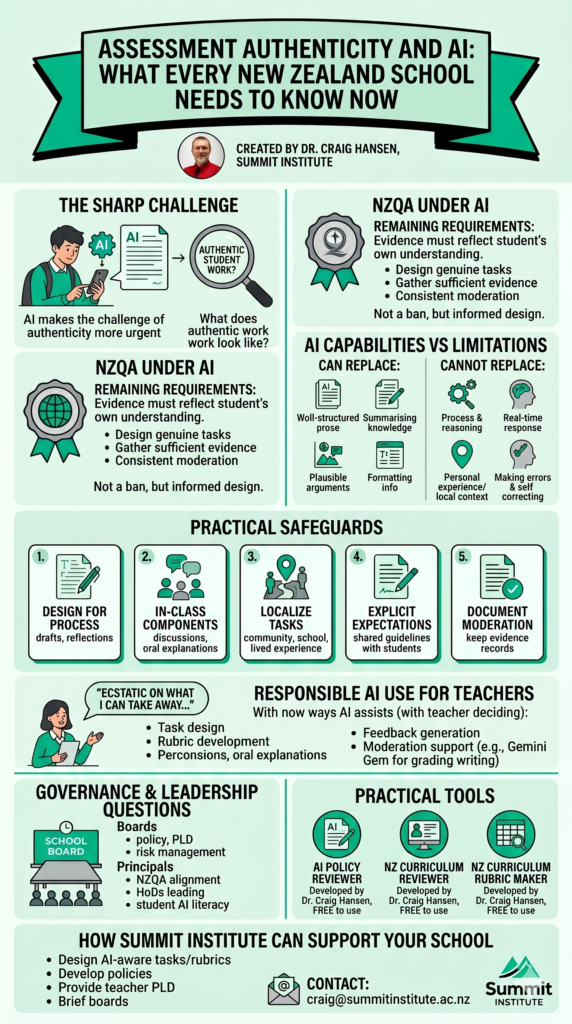
When a student can produce a polished essay, a detailed science report, or a structured argument in seconds using a free AI tool on their phone, the question schools face is no longer “is this student’s work their own?” in the traditional sense. The question is now: what does authentic student work look like, and how do we design assessments that still reveal it?
That is not a technology question. It is a professional and pedagogical one — and it requires a whole-school response.
“Came in today thinking I was confident in what my school and I knew about AI. I was extremely impressed and ecstatic on what I can take away to the other leaders from my school.”
— Senior leader, Waikato school
What “authenticity” means under NZQA in an AI-enabled world
NZQA’s requirements around authenticity have not fundamentally changed: evidence of student achievement must genuinely reflect what the student knows and can do. What has changed is the environment in which that evidence is gathered — and the tools students have access to when they produce it.
Under the current NZQA framework, schools and teachers carry significant responsibility for:
- Designing assessment tasks that elicit genuine student thinking
- Gathering sufficient evidence that the work represents the student’s own understanding
- Moderating that evidence consistently and fairly
AI makes each of these harder if assessments are not designed with it in mind — and easier to manage if they are.
The key shift NZQA is signalling is not a blanket ban on AI use in assessment. It is a call for deliberate, informed design — assessment tasks that are shaped by an awareness of what AI can and cannot do, and that are structured to surface student thinking in ways that AI cannot replicate on a student’s behalf.
What AI can — and cannot — replace in student work
Understanding this distinction is essential for good assessment design. AI is very good at:
- Producing well-structured, grammatically correct prose
- Summarising existing knowledge
- Generating plausible arguments from a prompt
- Formatting and presenting information
AI is not good at:
- Demonstrating process and reasoning specific to a student’s learning journey
- Responding in real time to follow-up questions or probing
- Reflecting on personal experience, local context, or cultural knowledge
- Making errors that reveal genuine thinking — and then correcting them with understanding
The practical implication for assessment design is clear: tasks that rely purely on a written product are more vulnerable. Tasks that incorporate process, conversation, reflection, or local and personal context are more resilient — and, as a bonus, are often more educationally meaningful.
Practical safeguards for internal and external assessment
Schools do not need to choose between embracing AI and protecting assessment integrity. The two are compatible — but only if safeguards are deliberate and consistent. Practical approaches being used by NZ schools include:
Design for process, not just product
Incorporate drafting stages, annotated bibliographies, or student reflections on how they developed their thinking. These are harder to generate through AI alone and give teachers evidence of authentic learning.
Use in-class components
A short in-class discussion, oral explanation, or written response tied to a piece of take-home work provides strong authenticity evidence. Students who genuinely understand their work can explain it; those who didn’t produce it often cannot.
Contextualise tasks to the local and the personal
Assessment tasks that ask students to apply learning to their own community, school, or lived experience are naturally more difficult to fake — and are often more engaging and culturally meaningful.
Be explicit with students about expectations
Clear, consistent classroom and department-level guidelines on acceptable AI use — developed transparently with students, not just handed down — build a shared understanding of what authentic work looks like and why it matters.
Document your moderation process
In a world where AI-generated work is harder to detect than copied text, the quality of your moderation process matters more than ever. Keep records of the evidence base for assessment decisions.
“Roadmapping use of AI to support the layers of school structure.”
— Deputy principal, Auckland school
Where AI can responsibly support assessment design and feedback
Assessment authenticity is not about excluding AI from the professional work of teachers. Used well, AI can strengthen assessment practice significantly:
- Task design: AI can generate draft assessment prompts, suggest variations for different learner needs, or help teachers identify potential weaknesses in a task before it is used.
- Rubric development: AI can draft success criteria or rubric descriptors that teachers then review, contextualise, and adapt — saving significant time without removing professional judgement.
- Feedback: AI can help teachers draft comment banks, generate starter phrases for written feedback, or produce differentiated feedback templates — all of which teachers then personalise and own.
- Moderation support: Tools like the Gemini Gem for grading writing against the Refreshed NZ Curriculum can serve as a moderation partner — checking teacher judgements, not replacing them.
The principle in each of these cases is the same: AI assists, the teacher decides.
What boards and principals should be asking about assessment integrity
Assessment authenticity is not only a classroom issue. It is a governance and leadership issue — and school boards and principals need to be part of the conversation.
Boards should be asking:
- Does our school have a clear, current policy on acceptable AI use in assessment — for both students and staff?
- Are our teachers receiving PLD that supports them to design AI-aware assessments?
- How are we managing the risk of inconsistent expectations across departments or year levels?
- What does our approach to assessment integrity communicate to our community about our values?
Principals and senior leaders should be asking:
- Do our assessment practices align with NZQA’s current guidance on authenticity?
- Are our HoDs equipped to lead this conversation in their departments?
- Are we building student AI literacy alongside our academic integrity expectations — so students understand why authenticity matters, not just that it is required?
These are not one-off questions. They belong in a regular leadership and governance conversation as AI tools continue to develop rapidly.
Practical tools for schools
Dr. Craig Hansen has developed three tools to support schools working through AI policy, governance, and curriculum-aligned assessment design. All are free to use.
AI Policy Creator and Reviewer
Generate a draft AI governance policy for your school, or upload your existing policy for review — available in two versions so you can use whichever platform your school already works with:
- ChatGPT GPT: Dr Craig’s AI Policy Reviewer & Generator
- Gemini Gem: AI Policy Reviewer (Google)
NZ Refreshed Curriculum Rubric Maker
Paste any teaching sequence statement from the Refreshed NZ Curriculum and this tool will generate a rubric aligned to the Ministry of Education’s Using the Rubrics Guide — a practical starting point for teachers designing curriculum-aligned assessment tasks:
- Gemini Gem: NZ Curriculum Rubric Maker
How Summit Institute can support your school
Assessment authenticity sits at the heart of what Summit Institute works on with New Zealand schools. Craig works with teachers, senior leadership teams, and school boards to:
- Design AI-aware assessment tasks and rubrics aligned to NZQA requirements
- Develop clear, consistent school-wide AI use policies that address assessment integrity
- Provide practical PLD for teachers on designing assessments that AI cannot shortcut
- Brief boards on their governance responsibilities around assessment integrity and AI risk
To discuss what this looks like for your school, contact to schedule an introductory chat: craig@summitinstitute.ac.nz
About the author
Dr. Craig Hansen is an AI in education specialist and founder of Summit Institute, a New Zealand private training provider. He works with teachers, school leaders and school boards across Aotearoa New Zealand — from primary through secondary — to develop practical, culturally responsive approaches to AI in education.