Artificial intelligence is no longer just a classroom issue. It now affects governance, policy, assessment integrity, student wellbeing, privacy, and community trust, all of which sit squarely within a school board’s oversight role.
Boards in New Zealand are responsible for setting strategic direction, developing policy, consulting with the community, and ensuring student safety and inclusive outcomes, so AI needs to be treated as a governance matter rather than left as an informal staff issue. This page outlines how boards can approach AI in a practical, culturally responsive, and responsible way.
Understand the board’s role
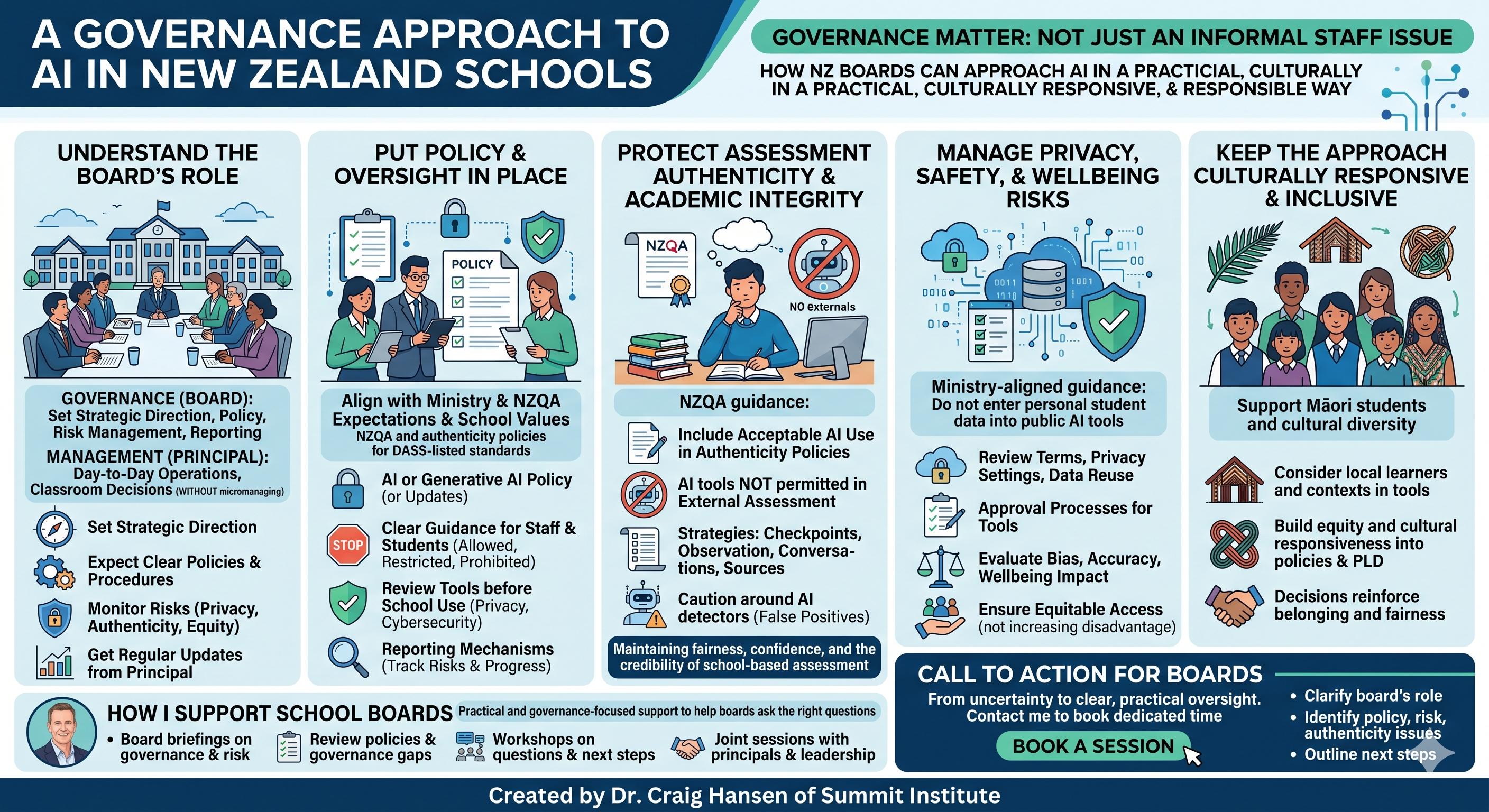
A school board is responsible for governance, while the principal manages day-to-day operations. In practice, that means the board should set expectations for AI oversight, policy, risk management, and reporting, without trying to micromanage classroom decisions.
Board-level AI governance includes:
- Setting the strategic direction for how AI fits with the school’s values and goals.
- Expecting clear policies and procedures for acceptable AI use.
- Monitoring risk areas such as privacy, assessment authenticity, wellbeing, and equity.
- Asking for regular updates from the principal on implementation, issues, and next steps.
Put policy and oversight in place
Schools are increasingly developing AI policies that align with Ministry and NZQA expectations and with their own school values. NZQA states that schools with consent to assess DASS-listed standards must have an authenticity policy that includes the acceptable use of AI.
Boards should expect to see:
- An AI or generative AI policy, or AI-specific updates within existing policies.
- Clear guidance for staff and students about when AI use is allowed, restricted, or prohibited.
- A process for reviewing tools before they are approved for school use, especially where privacy and cybersecurity are concerned.
- Reporting mechanisms so the board can track risks, incidents, and progress over time.
Protect assessment authenticity and academic integrity
NZQA guidance makes clear that schools must include acceptable AI use in authenticity policies, and that generative AI tools are not permitted in external assessment. NZQA also recommends strategies such as checkpoints, observation, follow-up conversations, source acknowledgement, and caution around AI detectors because of false positives.
For boards, this means asking leadership:
- How is the school updating assessment policies to reflect AI use?
- How are staff being supported to design AI-aware assessments and authenticity checks?
- How are students and whānau being told what counts as acceptable and unacceptable AI use?
This is not just about cheating; it is about maintaining fairness, confidence, and the credibility of school-based assessment.
Manage privacy, safety, and wellbeing risks
Ministry-aligned guidance warns schools not to enter personal student data into public AI tools and stresses the need to review terms of use, privacy settings, and data reuse carefully. School AI policies are also emphasising safety, transparency, equity, and approval processes for tools before they are used in school contexts.
Boards should be asking:
- What student or staff data could be exposed through AI tools?
- What approval process exists before a tool is adopted?
- How does the school evaluate bias, accuracy, and the impact on student wellbeing?
- How is the school ensuring equitable access and not increasing disadvantage for some learners?
Keep the approach culturally responsive and inclusive
Boards are expected to support inclusive practice and equitable outcomes for Māori students and New Zealand’s cultural diversity as part of their broader governance responsibilities. In AI terms, that means paying attention to cultural responsiveness, representation, bias, and whether AI-enabled practices reflect the communities the school serves.
A culturally responsive board-level approach includes:
- Expecting leadership to consider whether AI tools and content reflect local learners and contexts.
- Asking how equity, inclusion, and cultural responsiveness are being built into policies and PLD.
- Ensuring AI decisions do not undermine the school’s commitment to belonging, fairness, and inclusive outcomes.
How I support school boards
Support for school boards is designed to be practical and governance-focused rather than technical. The aim is to help boards ask the right questions, establish sensible oversight, and work productively with principals and leadership teams.
This support can include:
- Board briefings on AI governance, risk, policy, and oversight
- Review of current school AI policies and governance gaps
- Workshops on board questions, reporting expectations, and next steps
- Joint sessions with board chairs, principals, and leadership teams to clarify roles and responsibilities
Call to action for boards
If your board wants to move from uncertainty to clear, practical oversight of AI in your school, contact me to book dedicated time together so we can move things forward in a focused and useful way.
In that session, we can:
- Clarify the board’s role in AI governance and oversight
- Identify the most important policy, risk, and authenticity issues for your context
- Outline practical next steps for policy, reporting, and leadership engagement
To book, contact me via this website or on LinkedIn or use the contact form on this site with the subject line “Board AI governance session”.