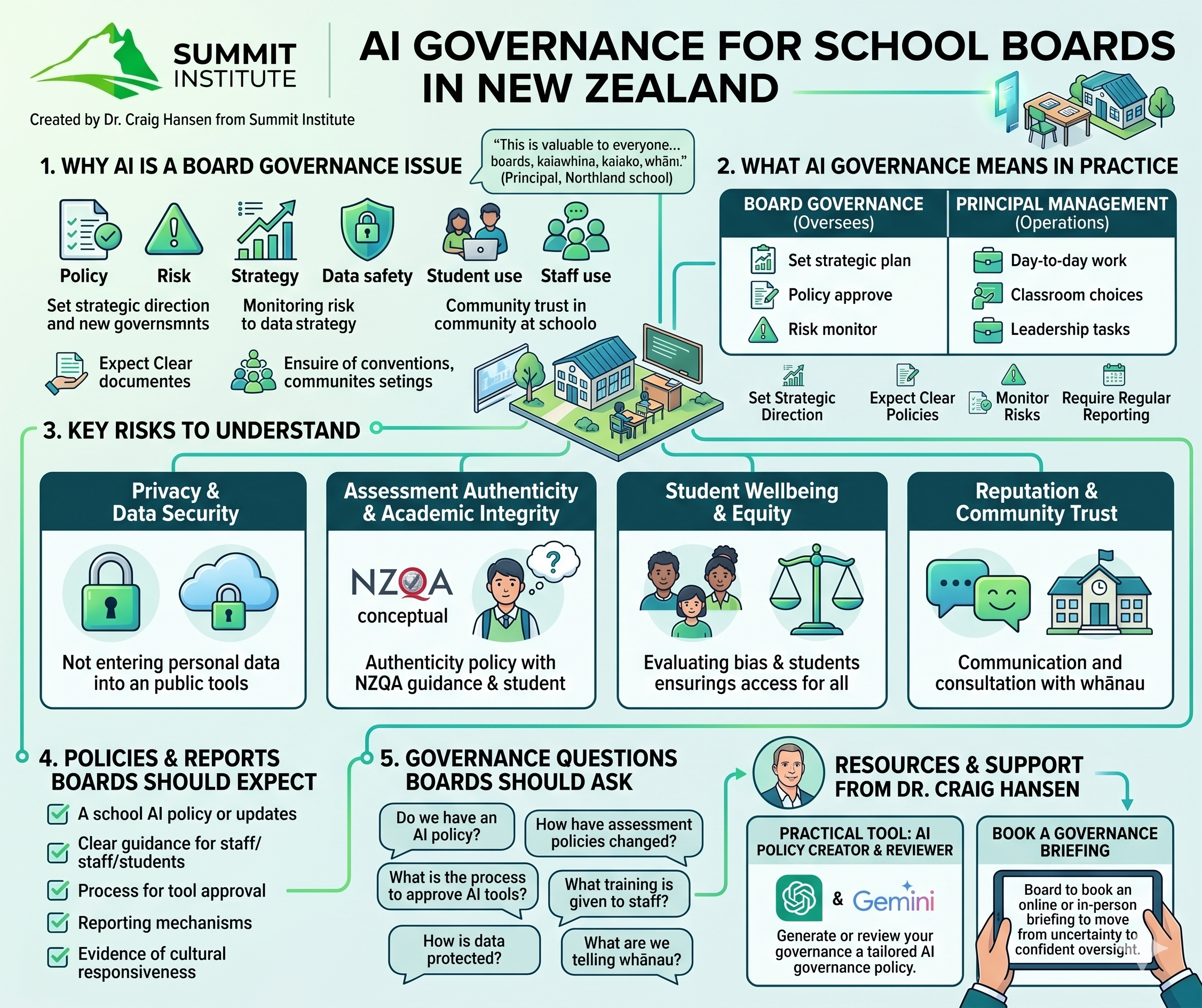
Artificial intelligence has arrived in New Zealand schools faster than most boards anticipated. It is no longer just a classroom tool issue — it now sits squarely within a board’s core responsibilities around policy, risk, student wellbeing, assessment integrity, and community trust.
Dr. Craig Hansen has worked with more than one thousand schools across New Zealand on AI in education. One of the clearest patterns in that work is this: schools that handle AI well are the ones where the board is engaged, informed, and asking the right questions. Schools that struggle tend to be the ones where AI has been left entirely to individual teachers without any governance framework in place.
“This is valuable to everyone within a kura — boards, kaiawhina, kaiako, whānau.” — Principal, Northland school
This article outlines what AI governance for school boards looks like in practice, and how your board can move from uncertainty to clear, confident oversight.
Why AI is now a school board governance issue
Boards in New Zealand are responsible for setting strategic direction, developing policy, ensuring student safety, consulting with the community, and monitoring risk. All of those responsibilities are now directly affected by AI.
Students are using generative AI tools for assignments. Staff are using AI to plan lessons, write reports, and create resources. Schools are being approached by vendors selling AI-powered platforms. And whānau are asking questions about how their children’s data is being used.
None of this can be left to chance. AI governance for school boards means putting deliberate oversight in place — not micromanaging every classroom decision, but setting clear expectations and ensuring leadership has the policy frameworks, reporting processes, and cultural responsiveness to manage AI responsibly.
What AI governance means in practice for your board
Governance is distinct from management. The board sets direction and oversees risk; the principal and senior leadership team handle day-to-day operations.
In AI terms, board-level AI governance includes:
- Setting the strategic direction for how AI aligns with the school’s values and community
- Expecting and approving clear policies on acceptable AI use for staff and students
- Monitoring risks around privacy, assessment authenticity, student wellbeing, and equity
- Requiring regular reporting from the principal on AI implementation, issues, and progress
- Asking questions about how AI decisions reflect the school’s commitment to culturally responsive, inclusive practice
Your board does not need to understand the technical details of every AI tool. It does need to know that oversight is in place and that leadership is managing AI responsibly on behalf of your school community.
Key risks your board needs to understand
AI introduces a set of risks that sit directly within a board’s oversight mandate. The most significant are:
Privacy and data security. Ministry-aligned guidance is clear that student and staff personal data must not be entered into public AI tools. Boards should expect a clear approval process for any AI tool before it is used in school contexts, including review of terms of service, privacy settings, and data handling practices.
Assessment authenticity and academic integrity. NZQA requires schools with consent to assess DASS-listed standards to have an authenticity policy that includes the acceptable use of AI. Generative AI is not permitted in external assessment. Boards should ask how assessment policies have been updated and how staff and students are being guided on what counts as acceptable use.
Student wellbeing and equity. AI tools can introduce bias, inaccuracy, and inequitable outcomes, particularly for Māori and Pacific learners and students from lower-income communities. Boards should ask how the school is evaluating tools for bias and ensuring equitable access.
Reputation and community trust. If AI is being used in ways that whānau do not know about or have not been consulted on, it can quickly erode community confidence. Board oversight helps ensure that communication and consultation are built into the school’s AI approach from the start.
What policies and reports your board should expect
A well-governed school will have documentation your board can review and act on. At a minimum, boards should expect to see:
- A school AI policy, or AI-specific updates to existing acceptable use and assessment policies
- Clear guidance for staff and students on when AI use is permitted, restricted, or prohibited
- A process for evaluating and approving AI tools before adoption
- Reporting mechanisms so the board can track risks, incidents, and progress over time
- Evidence that AI practice reflects the school’s cultural values and community context
If these are not yet in place, that is the starting point for your governance conversation with the principal.
Questions your board should ask
Craig’s work across more than a thousand schools has shown that the most effective boards tend to ask a consistent set of governance questions. These include:
- Does our school have an AI policy, and has it been reviewed recently?
- What process does leadership follow before approving a new AI tool for school use?
- How is student and staff data protected when AI tools are in use?
- How has our assessment authenticity policy been updated to address generative AI?
- How are staff being supported to use AI responsibly and in a culturally responsive way?
- What is being communicated to whānau about how AI is being used in our school?
- What risks have been identified, and what steps are being taken to manage them?
These questions do not require technical expertise. They require governance confidence — and that is exactly what Craig’s board governance briefings are designed to build.
“I want to run whole staff PLD on this and give all our teachers the opportunity to learn what I have today.” — Senior leader, Auckland school
“Roadmapping use of AI to support the layers of school structure.” — Deputy principal, Auckland school
A practical tool to give your board a head start
One of the most common challenges Craig hears from school boards is that they do not know where to start with AI policy. To address this directly, Craig has developed a purpose-built AI policy creator and reviewer tool — available in both a ChatGPT custom GPT and a Gemini Gem version for Google schools.
The tool does two things:
- Generate a draft AI policy. The tool produces a draft AI governance policy tailored to your school’s context, built on good practice drawn from Craig’s work with more than a thousand New Zealand schools and from current Ministry and NZQA guidance. It gives your board the right understandings and perspectives to have a meaningful policy discussion.
- Review an existing AI policy. If your school already has an AI policy in place, your board or principal can upload it and receive a structured review — identifying gaps, risks, and areas to strengthen against current good practice.
It is not a replacement for professional advice or board decision-making. It is a well-structured, practical starting point your board and principal can work through together — grounded in the realities of New Zealand schools.
ChatGPT version (Dr. Craig’s AI Policy Reviewer and Generator): Access the ChatGPT AI policy tool here
Gemini Gem version (for Google schools): Access the Gemini AI policy tool here
Book a governance briefing with Dr. Craig Hansen
If your board wants to move from uncertainty to clear, practical AI governance for your school, Dr. Craig Hansen offers dedicated board governance briefings for New Zealand school boards.
In a governance briefing, Craig will:
- Walk your board through the key AI governance responsibilities in plain, accessible language
- Help you identify the most important policy, risk, and assessment authenticity issues for your school context
- Outline practical next steps for policy development, reporting, and leadership engagement
- Answer your board’s questions directly, without technical jargon
Briefings can be delivered online or in person and are designed to give your board the confidence to lead responsible AI governance effectively.
“AI is the biggest equity move we can make in our generation.” — Dr. Craig Hansen, quoted by a principal, Far North school
To book a governance briefing with Dr. Craig Hansen, use the contact form on this website with the subject line “Board AI governance briefing,” or connect directly on LinkedIn.
To use the AI policy creator and reviewer tool, choose the version that suits your school — the ChatGPT version or the Gemini Gem version for Google schools — and generate or review a draft AI governance policy your board can discuss at your next meeting.
Both are practical first steps toward responsible, confident AI governance for your school — grounded in what has worked for more than a thousand New Zealand schools.