
Artificial intelligence has moved from hype to staffroom reality in a very short time. Tools that generate text, images, lesson ideas, and even feedback are already in the hands of teachers, students, and whānau. As a principal, you don’t have the luxury of ignoring it – you’re expected to keep ākonga safe, protect assessment integrity, and lead your school’s response in a way that aligns with your values and community.
This article offers a practical roadmap to help you take confident first steps, with a focus on culturally responsive, safe AI use that supports – not replaces – the human heart of your school.
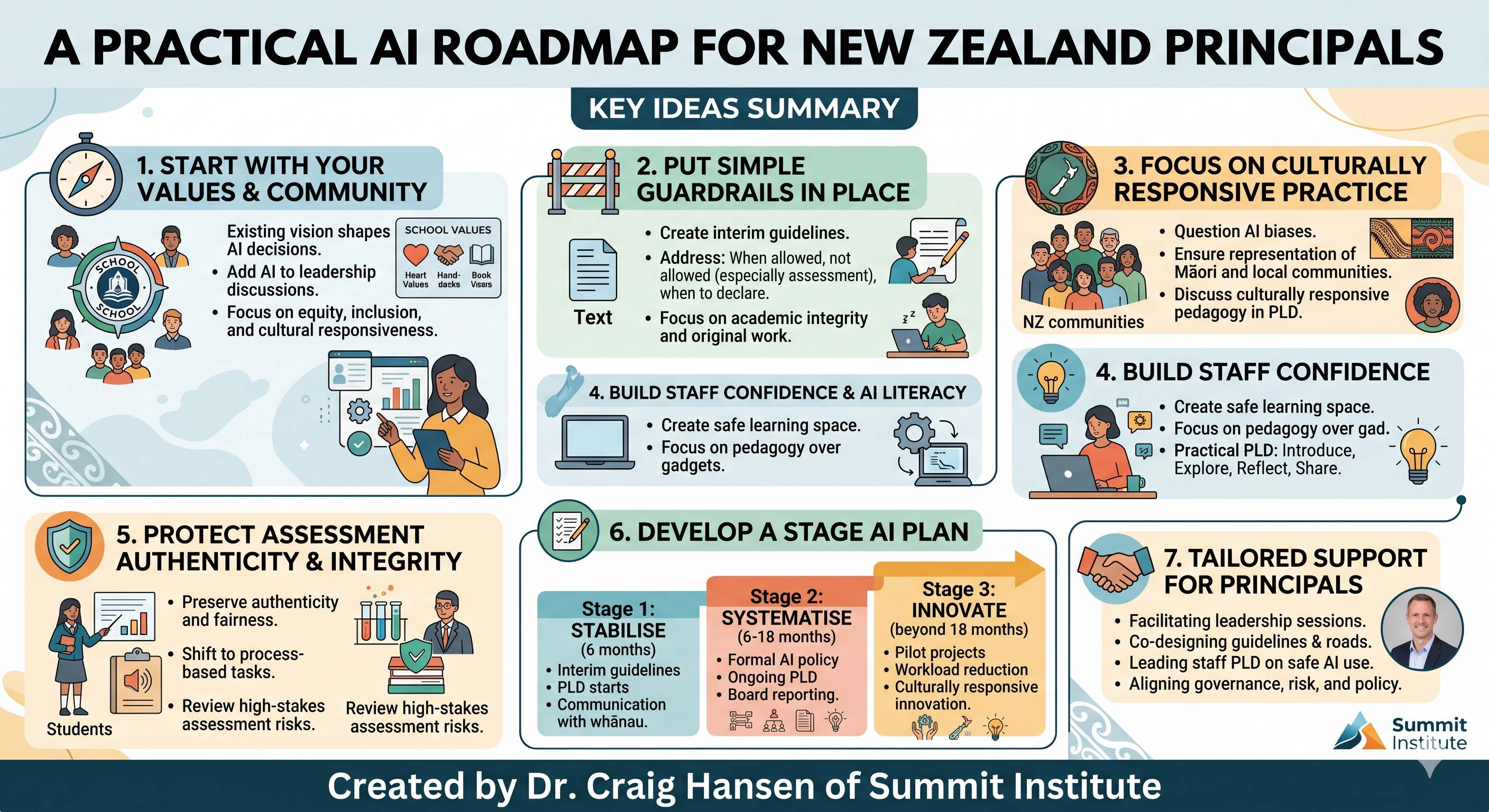
1. Start with your values and community
Before talking about tools, start with who you are as a school. Your existing vision, values, graduate profile, and strategic plan should shape your AI decisions, not the other way around.
- Re‑read your school values and ask, “What do these mean in an AI‑enabled world?”
- Think about how AI might affect your commitments to equity, inclusion, and cultural responsiveness.
- Consider how your community might perceive AI – both the hopes and the fears.
A practical step this term:
- Add “AI and digital change” as a discussion item for your leadership team or curriculum leaders.
- Ask: What are we already seeing in classrooms? What worries staff? Where might there be opportunity?
Your goal at this stage is not to have answers. It’s to surface what matters most so future decisions stay anchored in your school’s identity.
2. Put some simple guardrails in place
Even if your school doesn’t have a formal AI policy yet, you can create interim guidelines that give staff and ākonga clarity. Think of these as “guardrails” rather than a full policy.
Key questions to address:
- When is AI use clearly allowed for staff and students?
- When is AI use clearly not allowed (especially for assessment)?
- When is AI use allowed but must be declared or discussed?
A practical step this term:
- Draft a one‑page “Interim AI Guidelines” document.
- Clarify expectations for assessment authenticity and academic integrity.
- Specify that AI‑generated work must be adapted and cannot be submitted as original unless clearly authorised.
- Emphasise that AI tools are assistants, not replacements, for both teachers and students.
Share this with staff first, invite feedback, and then communicate a clear version to students and whānau. Make it clear this is a living document that will evolve as guidance and experience grow.
3. Focus on culturally responsive, inclusive practice
AI tools are not neutral. They reflect the data and assumptions they’re trained on, which means they can easily reinforce bias or marginalise certain perspectives if we don’t actively counter that.
For New Zealand schools, culturally responsive AI use means:
- Being alert to whose stories, histories, and languages are missing or misrepresented in AI outputs.
- Encouraging staff and students to question AI responses: “Who’s centred here? Who’s invisible?”
- Making sure AI‑generated examples and scenarios reflect your ākonga and communities.
A practical step this term:
- Choose one or two staff meetings or PLD sessions to look at AI outputs together.
- Ask: How culturally responsive is this? Who is present? Who is absent?
- Discuss ways to adapt outputs so they better reflect your learners and local context.
You don’t have to be an AI expert to lead this; you’re drawing on your existing expertise in culturally responsive pedagogy and applying it to a new context.
4. Build staff confidence and AI literacy
Many teachers are already experimenting with AI. Others feel overwhelmed or anxious. Your job is to create a safe space for learning together, not to demand instant mastery.
AI literacy for staff includes:
- Understanding what generative AI is and isn’t.
- Knowing the strengths and limitations of common tools.
- Being able to design tasks that remain authentic even when AI exists.
- Modelling critical thinking, bias awareness, and ethical use.
A practical PLD sequence:
- Introduce – Short whole‑staff session explaining key concepts and showing a few practical examples.
- Explore – Hands‑on time where teachers try AI tools for planning, resources, and differentiation.
- Reflect – Subject or syndicate discussions: What worked? What didn’t? What worries you?
- Share – Staff share examples of how AI has genuinely reduced workload or improved learning, and where they’ve decided not to use it.
Frame PLD around “AI as assistant, not replacement” and “culturally responsive, safe practice” so the focus stays on pedagogy and wellbeing, not just gadgets.
5. Protect assessment authenticity and integrity
One of the biggest concerns for principals is assessment – especially for NCEA and high‑stakes tasks. The question is not whether students will use AI, but how you’ll preserve authenticity and fairness.
Practical actions:
- Work with curriculum leaders to identify which assessments are most vulnerable to AI misuse.
- Review how you gather evidence of learning – more in‑class, oral, or process‑based tasks can make AI misuse harder and genuine learning more visible.
- Help staff design assessment tasks that require personal reflection, local context, or process documentation, making “copy‑paste from AI” less tempting and less effective.
Communicate clearly with students and whānau about what “acceptable help” looks like and where AI use crosses a line. Reinforce that the goal is learning, not just handing in work.
6. Develop a staged AI plan for your school
Once you’ve surfaced values, set interim guardrails, started PLD, and tackled assessment hotspots, you can step back and sketch a simple AI roadmap.
Think in three stages:
Stage 1 – Stabilise (this term to 6 months)
- Interim AI guidelines in place.
- One or two staff PLD sessions delivered.
- Early identification of assessment risks and adjustments made.
- Initial communication with whānau about your school’s approach.
Stage 2 – Systematise (6–18 months)
- A more formal AI policy developed, consulted on, and adopted.
- Ongoing PLD woven into your annual plan.
- Clear processes for approving AI tools and reviewing their impact.
- Regular reporting to the board on AI‑related risks and progress.
Stage 3 – Innovate (beyond 18 months)
- Pilot projects where AI genuinely improves teaching, learning, or support (e.g., differentiated resources, translated communications, or workload reduction).
- Student voice and whānau voice built into reviews of AI use.
- Partnerships with other schools or organisations exploring culturally responsive, safe AI innovation.
You don’t have to get everything right immediately. What matters is that you are seen to be leading thoughtfully, protecting your community, and creating space for safe experimentation.
7. How I can support principals
If you’re a principal or member of a senior leadership team, you don’t need another 50‑page policy – you need practical, tailored support that honours your context, culture, and constraints.
Ways I can help include:
- Facilitating leadership team sessions to clarify your AI vision, values, and risk appetite.
- Co‑designing interim AI guidelines and a simple roadmap aligned to your school’s goals.
- Leading staff PLD on culturally responsive, safe AI use that reduces workload rather than adding to it.
- Working with you and your board to align AI governance, risk, and policy.
Your school doesn’t need to be “perfectly AI‑ready” to start. It just needs a principal willing to lead with curiosity, courage, and care.
Reach out to me here through Summit Institute, or find me on LinkedIn, where I can help your school lead the way with AI.